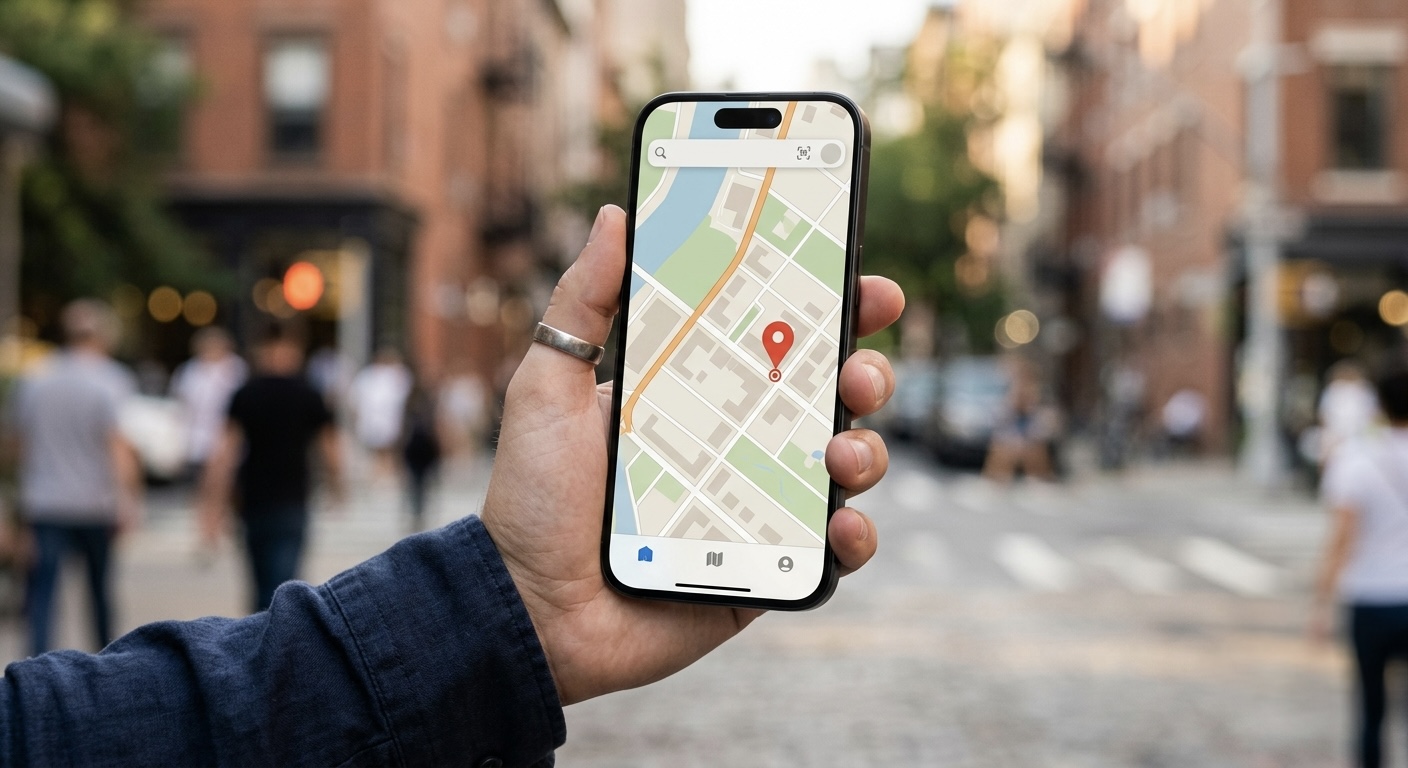
I typed "coffee" into Maps on Tuesday night the way I have a thousand times before, half paying attention, looking for something open late. The first result had a small blue badge on it I had not seen before. Ad. Four letters, in a corner, in an app I have never once thought of as a place that sells anything.
That badge is new. Apple confirmed this week that Maps has started showing ads in the United States and Canada, with the rollout expanding to more users over the coming weeks (9to5Mac). Two placements so far. A sponsored entry inside Suggested Places on the search screen, the row you see before you have typed anything, and a marked listing inside your actual search results when it is judged relevant. Both are formatted to look almost identical to a normal business listing, badge aside.
The claim, in Apple's own words
Here is the sentence doing all the work, straight from Apple's statement on the launch. "A user's location and the ads they see and interact with in Maps are not associated with a user's Apple Account." Apple adds that the personal data used to serve an ad stays on the device, is not collected or stored by Apple, and is not shared with third parties. The company frames the whole thing as consistent with what it calls its privacy-first approach to advertising, the same language it has used for years to describe how ads work in the App Store search tab and in Apple News and Stocks.
I want to be fair to that claim before I push on it, because it is not marketing fluff in the way "we take your privacy seriously" usually is. It is specific. It says your Apple Account, the thing tied to your name, your email, your payment method, is not the thing an advertiser is bidding against. It says the targeting signal, whatever it is, lives and dies on your phone. If that is true as described, it is a meaningfully different model from how Google or Meta sell location-adjacent ads, where the whole business is built on a durable, cross-app profile of you that gets more valuable the longer they hold it.
Apple has run something like this playbook before. Search Ads in the App Store has for years used on-device signals rather than a stored advertising profile, and it is genuinely one of the more privacy-respecting ad products in mobile. So when Apple says Maps is built the same way, that is not a company inventing a new promise on the spot. It is applying an existing model to a new surface.

What the claim does not cover
"Not associated with your Apple Account" is a narrower promise than "we do not know anything about you," and the gap between those two sentences is where I want people paying attention. Not tying an ad to your Account does not mean Apple has no signal to work with in the moment. It means whatever signal it uses is not filed away with your name on it afterward, as far as the stated policy goes. Your location right now, your search term right now, roughly where you tend to search from, that is plausibly enough to serve a relevant ad for a coffee shop without ever touching your Account, and Apple's statement is careful to describe the Account link specifically, not the existence of contextual targeting.
There is also no independent audit here that I could find, and I looked. This is Apple describing its own system, the way every ad platform describes its own system, and the honest caveat is that "on-device" and "not stored" are claims we are taking on trust from a company whose services revenue has grown into a business Apple discusses on earnings calls the way it once talked about iPhone units. Apple's fiscal 2025 services revenue was well into the tens of billions annually across the App Store, iCloud, Apple TV Plus, Apple Music, and advertising combined, and every new ad surface adds to that line. I am not accusing Apple of lying about Maps. I am saying a business with a growing incentive to sell more ad inventory deserves scrutiny on its privacy claims precisely because the incentive is real, not despite it.
The badge is the part I actually do not love
Set the data question aside for a second, because there is a simpler problem sitting right on the screen. Maps is a utility. People use it while walking, while driving, while distracted, glancing at a ranked list and tapping the first thing that looks right. A small blue Ad badge, formatted to sit quietly inside a list that otherwise looks like ranked, neutral results, asks a lot of a user's attention in a context that was never designed to reward careful reading. App Store search ads live in an app where people already expect to be sold something. Maps has spent a decade training people to trust that the top result is the closest or the best, not the one that paid.
I do not think that makes the ad dishonest. The badge exists, it is labeled, and Apple did not try to hide it. I think it makes the ad easy to miss, which is a different problem with the same practical effect, and it is the part of this rollout I would have designed differently if the goal really is "trust us, this is still neutral."
Why this matters here
I build small, on-device iPhone and iPad apps as a nights and weekends studio, and my entire pitch to people is the opposite of what just landed in Maps. No ads inside the app, no tracking, nothing leaves your device by default. Apple's Maps model is closer to my studio's approach than to Google's or Meta's, and I think that is worth saying plainly instead of reflexively piling on. But there is a real difference between an app that has no ad business to protect and a trillion dollar company deciding, feature by feature, which parts of iOS are still ad-free. Today it is Maps. The honest question is which surface is next, and whether the same on-device promise holds every time Apple answers it.
The caveats, said once and plainly. Apple's privacy claims here are the company's own description of its system, not an independently audited one. The rollout is US and Canada only as of this week, with other regions and the full ad load still to come, so what the ad experience looks like in three months may differ from what I am describing today. Verified August 28, 2026.
Comments
Be kind and stay on topic. Comments are reviewed before they appear.