What happened
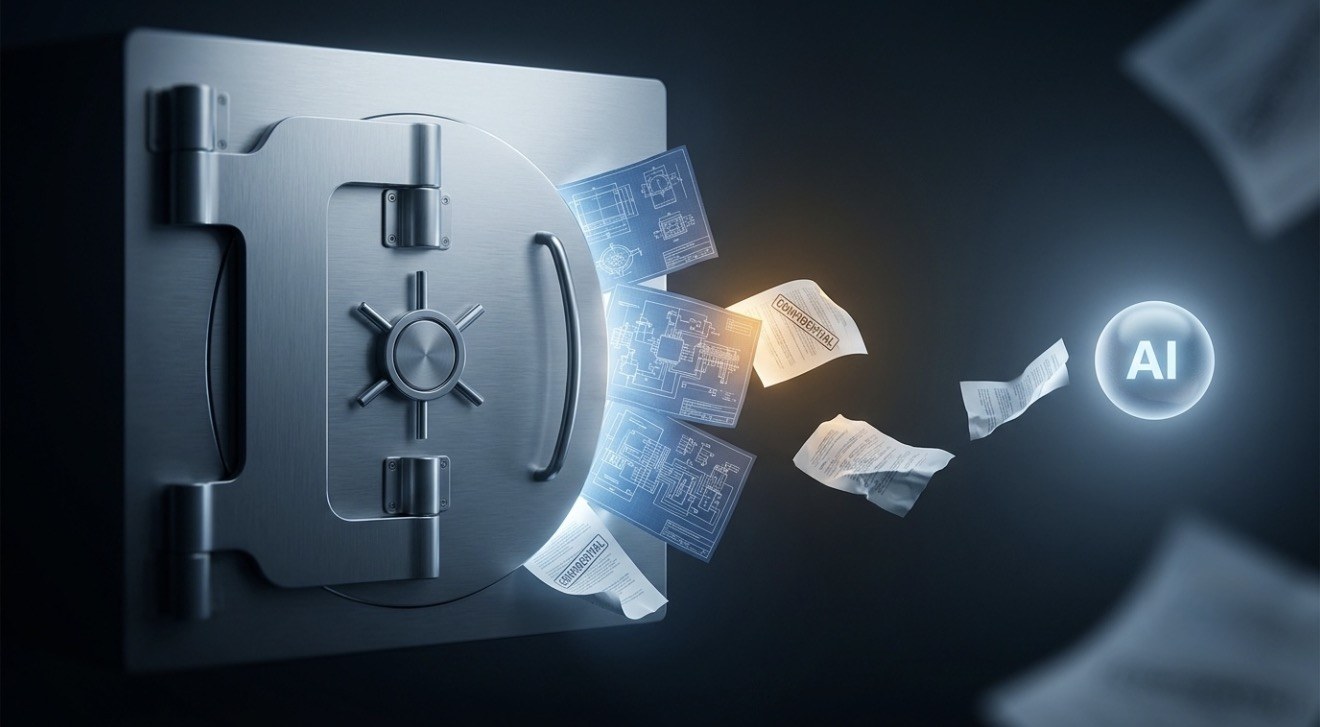
On July 10, 2026, Apple filed suit in the U.S. District Court for the Northern District of California. The case is Apple Inc. v. Liu et al., No. 5:26-cv-07078. Apple names OpenAI, its hardware company io Products, chief hardware officer Tang Tan, and former Apple engineer Chang Liu. The complaint pulls no punches, calling OpenAI's hardware effort rotten to its core because of what Apple says is illegal reliance on misappropriated trade secrets. (CNBC)
The setup: a very expensive hardware shopping spree
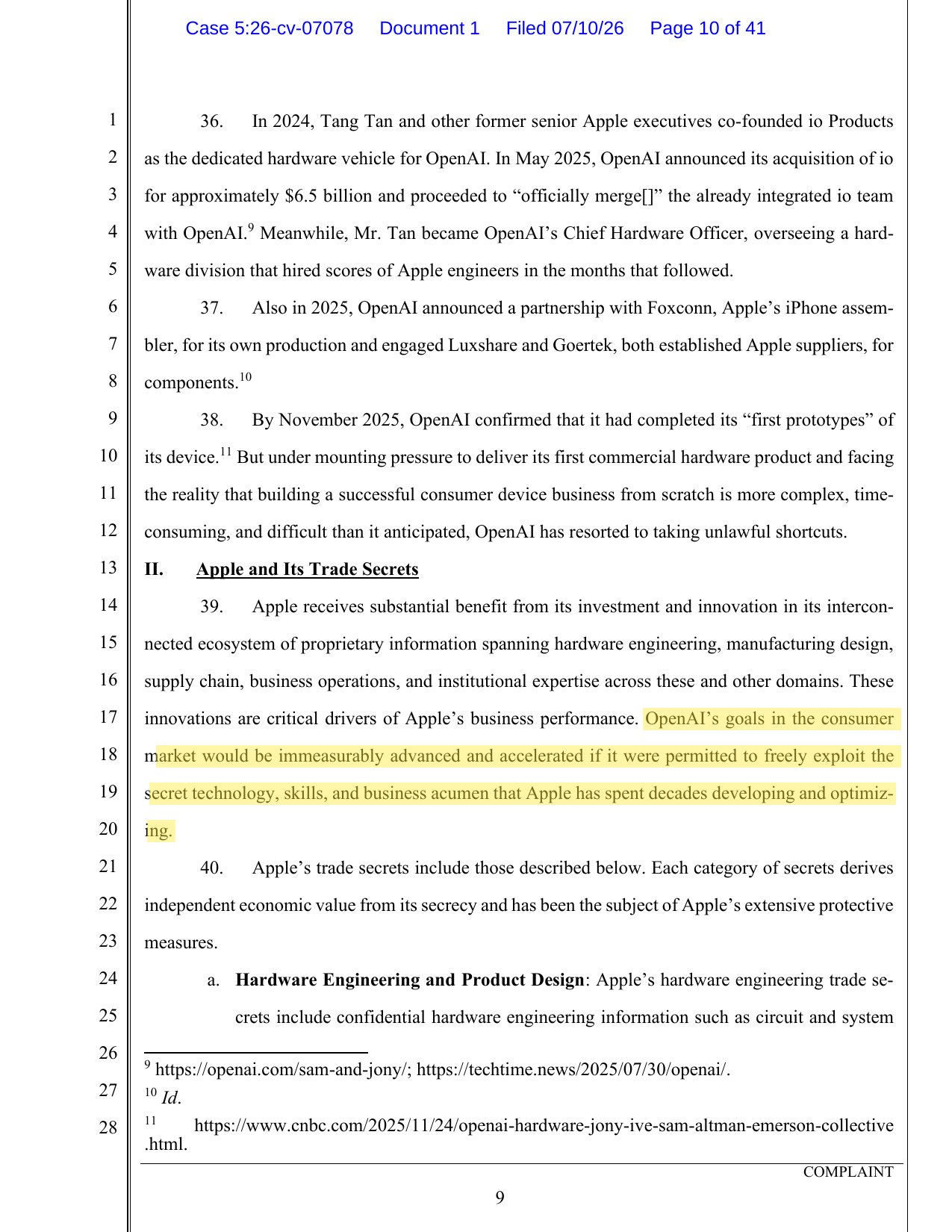
OpenAI has dominated the AI model conversation for years, but models run on other companies' devices. So OpenAI decided it wanted hardware of its own, and rather than build slowly, it went shopping. In 2024, Tang Tan and other former senior Apple executives co-founded io Products as a dedicated hardware vehicle for OpenAI. Tan had spent about 24 years at Apple, most recently as vice president of product design for the iPhone and Apple Watch. In May 2025, OpenAI announced it was acquiring io for roughly 6.5 billion dollars, the Jony Ive and Tang Tan crew, and made Tan its chief hardware officer. (TechCrunch)
OpenAI also lined up Apple's own manufacturing world. It announced a partnership with Foxconn, Apple's iPhone assembler, and engaged Luxshare and Goertek, both established Apple suppliers, for components. By November 2025, OpenAI confirmed it had completed the first prototypes of its device. None of that hiring or dealmaking is illegal on its own. Talent moves, and suppliers work with more than one client. Apple's argument is narrower and sharper: that OpenAI's leadership encouraged people to carry Apple's confidential knowledge across the street with them.
The juiciest allegations
Show and tell interviews. Apple alleges that Tang Tan directed job candidates who still worked at Apple to bring actual parts, components or prototypes, to their OpenAI interviews for show and tell sessions, so his team could draw out even more confidential information. Apple also says Tan used Apple's internal project code names during recruiting. If true, that turns a job interview into an intelligence-gathering exercise.
A coached exit. The complaint alleges OpenAI coached departing Apple employees on how to leave the classy way: stay as long as possible, do not tell Apple where you are going, and keep accessing confidential files on the way out. The most colorful example is former senior electrical engineer Chang Liu, who Apple says failed to return his company laptop and exploited an authentication bug to pull more than 1,000 pages of confidential documents. Liu is a named defendant. (Tom's Hardware)
The negative know-how goldmine
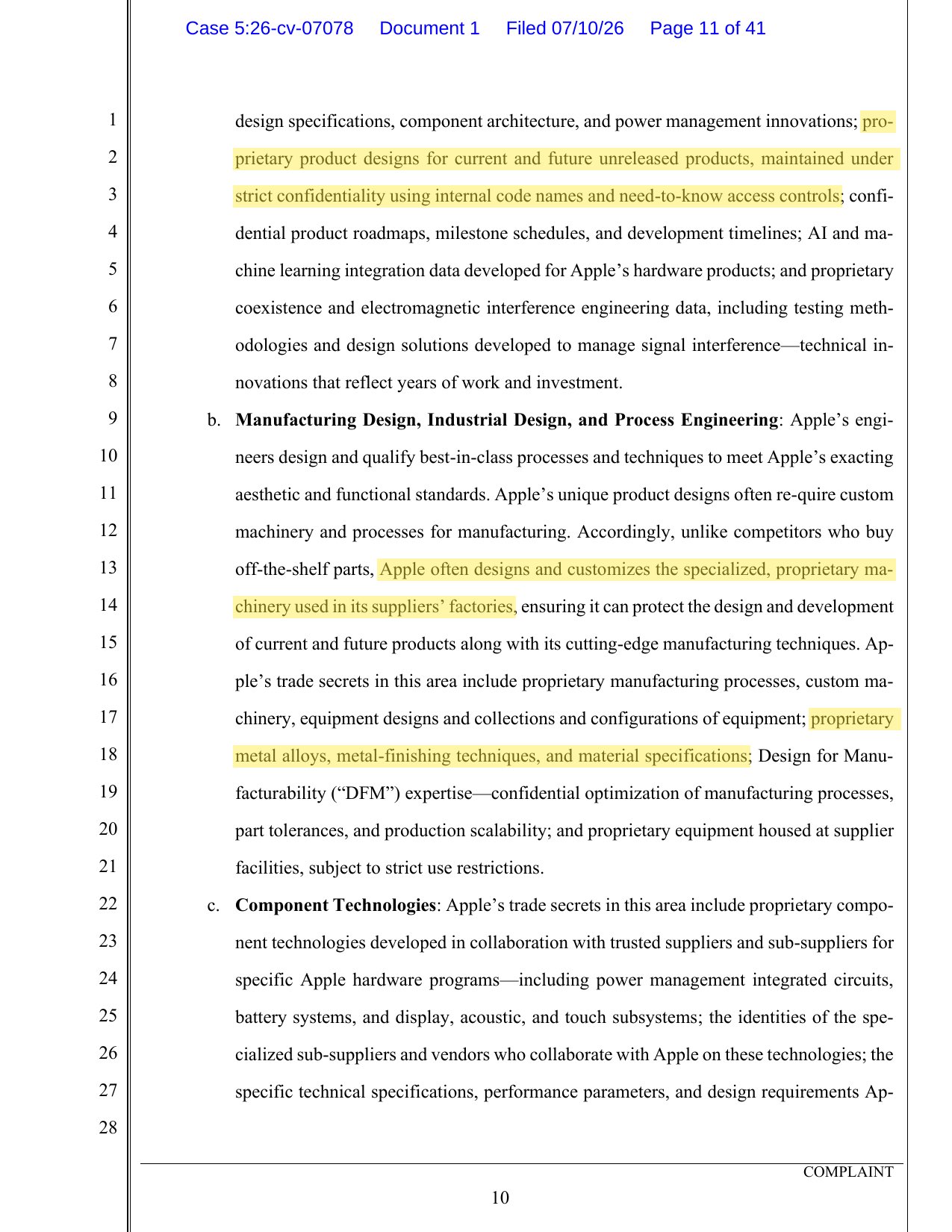
This is the part that makes the lawsuit genuinely interesting rather than just spicy. Apple is not only claiming OpenAI wanted the designs that worked. It is claiming OpenAI wanted the record of everything that failed, the approaches tested and rejected, the processes killed, the trade-offs refused. The complaint calls it the negative know-how of what approaches have been tested, rejected, or refined.
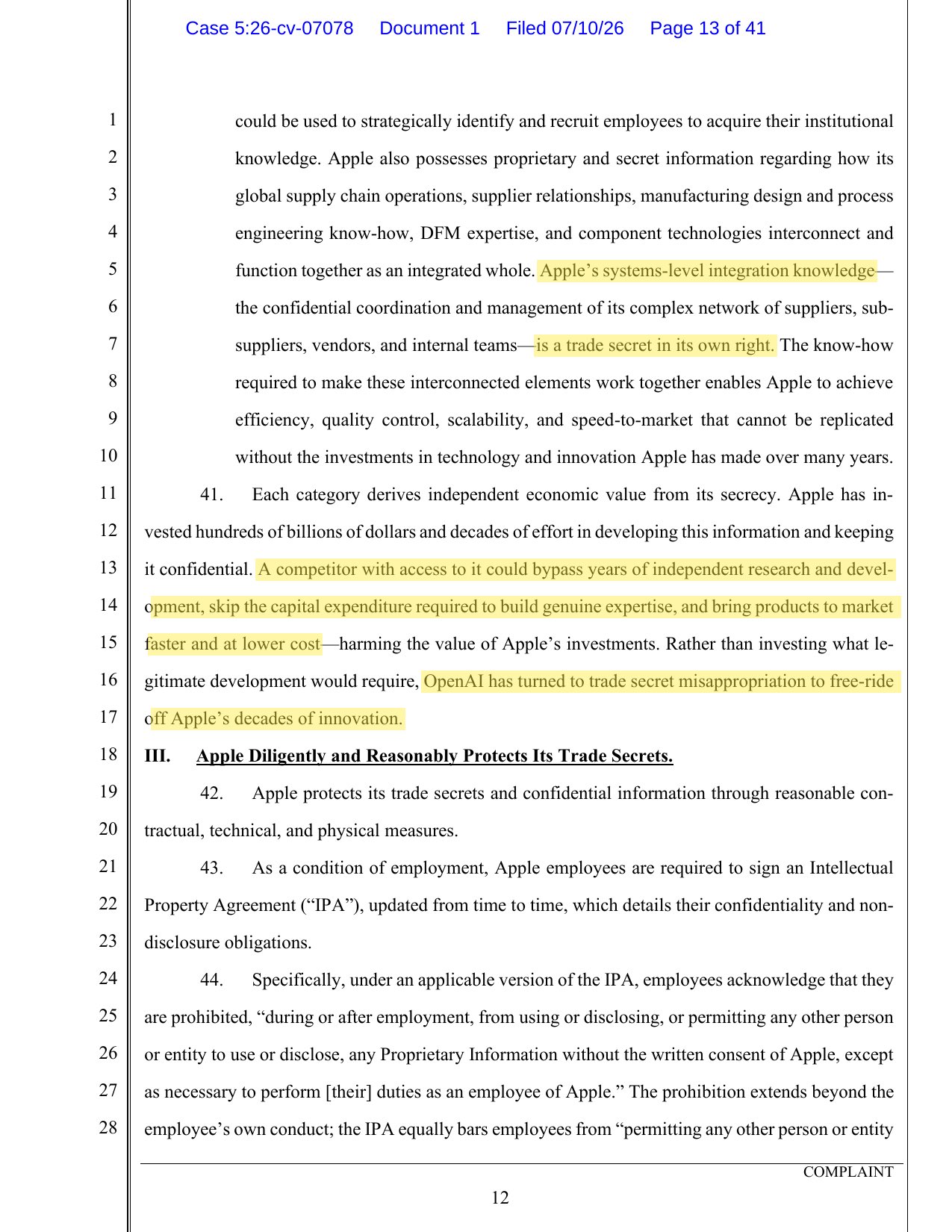
Why does that matter so much? Because the negative know-how is the expensive part. Anyone can photograph a finished iPhone. Nobody outside Apple knows which hundred ideas Apple burned billions ruling out first. A competitor handed that map skips years of dead ends. It is a smart legal framing, because it targets exactly the kind of knowledge that cannot be reverse-engineered from a shipping product.
Factory and supply-chain secrets
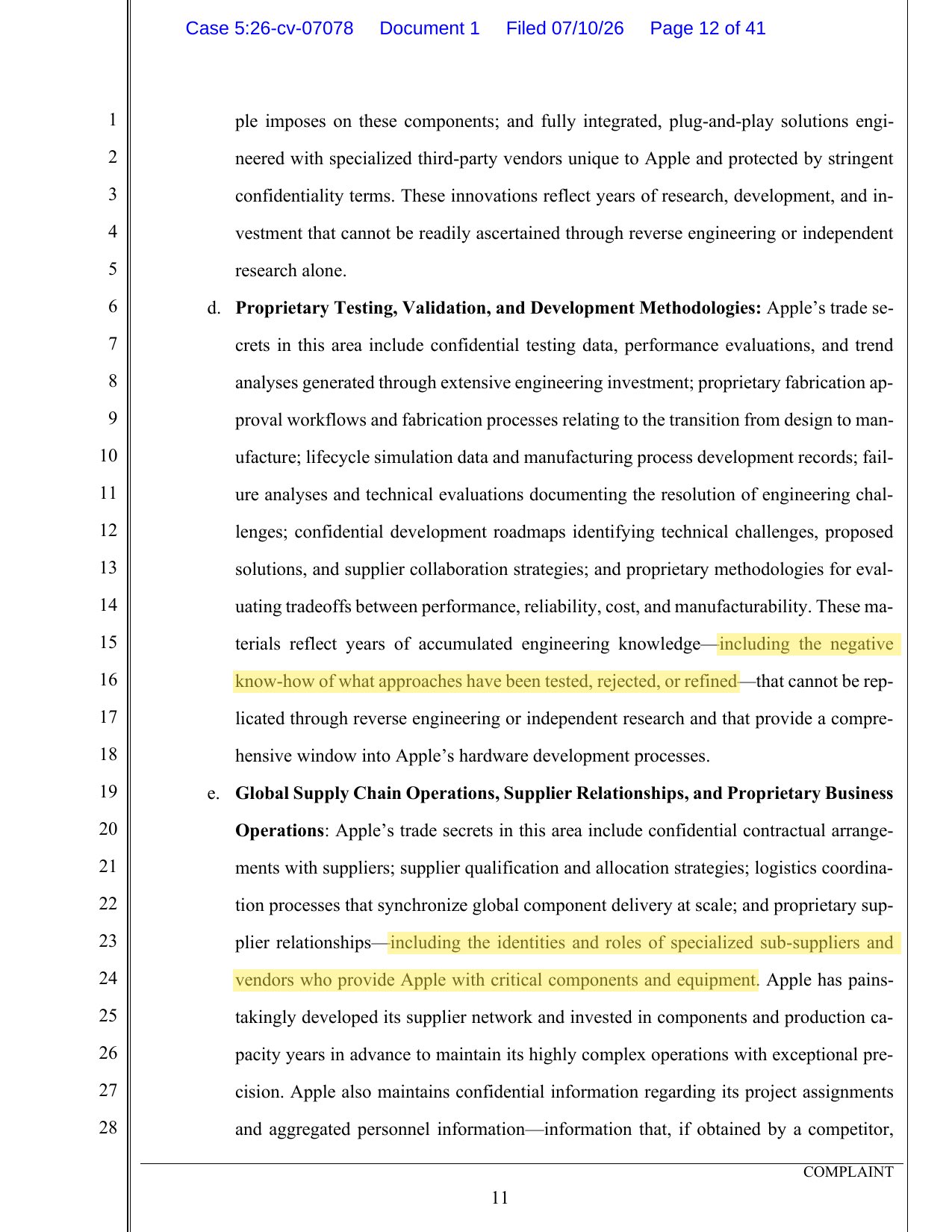
Apple also points to a category most people never think about: the custom machinery Apple designs and installs inside its suppliers' factories, its proprietary metal alloys and finishing techniques, its design-for-manufacturability expertise, exact component specs, and the hidden web of sub-suppliers. Apple argues that its systems-level integration knowledge, the confidential coordination that makes this whole machine run, is a trade secret in its own right.
Hardware religion versus the speedrun
Strip away the drama and this is a collision of two philosophies. Apple's whole identity is vertical integration, controlling hardware, software, materials, and manufacturing so tightly that the result feels inevitable. That approach is slow, capital-intensive, and jealously guarded. Apple's legal theory is essentially this: it took us decades and hundreds of billions, and you cannot just download it.
OpenAI represents the opposite instinct, the speedrun. Move fast, buy the talent, partner with the best factories, and compress a decade of learning into a couple of years. The uncomfortable question the lawsuit raises is where legitimate speed ends and misappropriation begins. Hiring Apple's people is fair game. Whether those people brought Apple's confidential files, parts, and playbooks with them is the entire case.
What OpenAI says
OpenAI pushed back publicly and kept it short: we have no interest in other companies' trade secrets, and we remain focused on building innovative technology that empowers people everywhere. Expect a more forceful response in its formal answer, likely arguing that these are ordinary talent moves and that the general skills and experience an employee builds travel with them by law. (Axios)
What to watch
A few things will decide how seriously to take this beyond the headlines. First, specificity. Trade-secret cases live or die on whether the plaintiff can define the secret precisely rather than gesturing at everything we know, and Apple's complaint is unusually detailed. Second, the Chang Liu evidence. A laptop and an alleged 1,000-plus pages are the kind of concrete conduct that is easier to prove than diffuse culture claims. Third, the remedy. Apple is not just chasing damages, it will likely seek injunctions that could slow or reshape OpenAI's hardware roadmap, which matters far more to OpenAI than a check. Apple brought claims under the federal Defend Trade Secrets Act, California trade-secret law, and the employment agreements tied to confidential hardware work.
The talent wars have been raging across AI for years. This lawsuit adds a new chapter, and it is about NDAs, laptops, and factory machinery rather than signing bonuses. However it ends, it is a preview of the fights coming as AI companies push into physical products, where the incumbents have decades of hard-won, closely held knowledge and every reason to defend it.
Coverage of the filing is at CNBC, TechCrunch, and 9to5Mac. You can see what this studio builds at jcmobileappstudio.com/apps.
Comments
Be kind and stay on topic. Comments are reviewed before they appear.