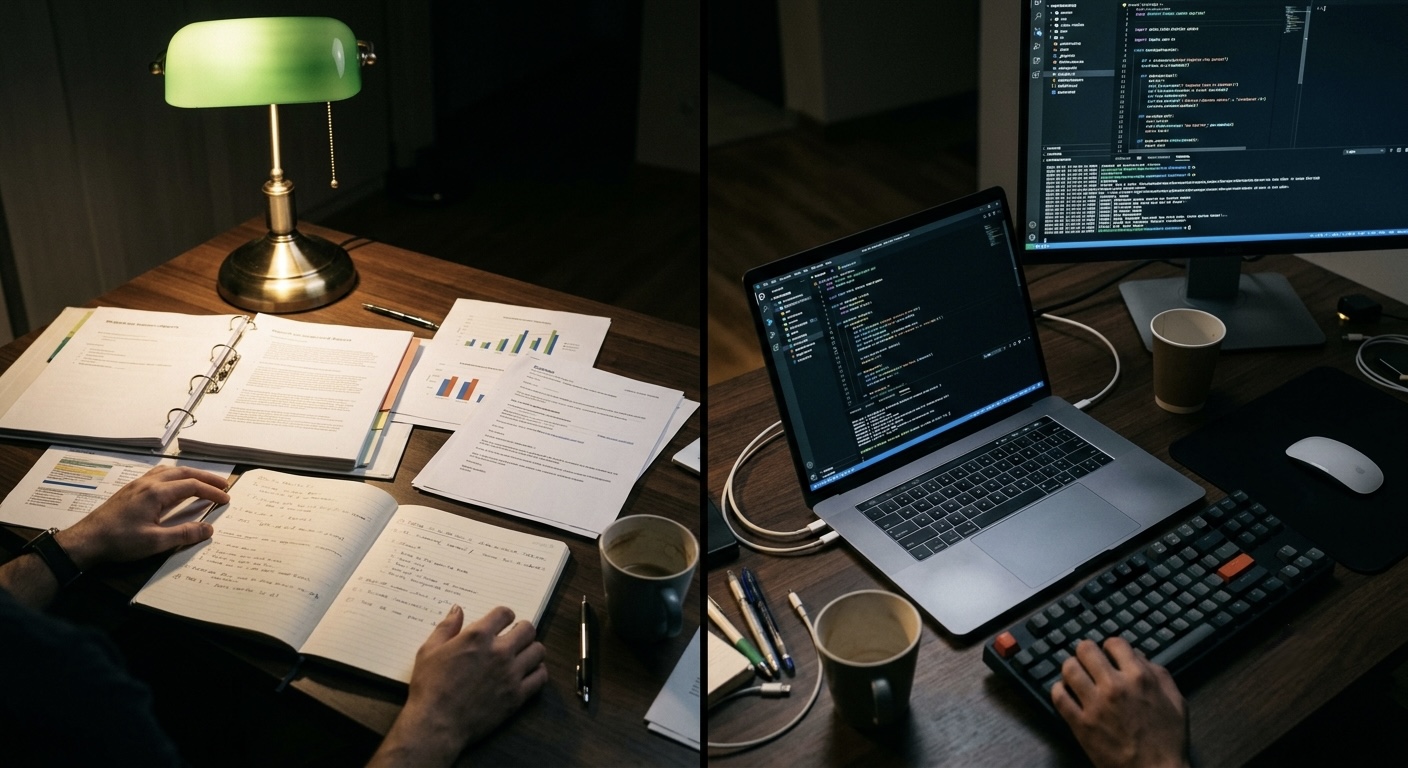
Here's what my Tuesday looked like last week. FMLA paperwork in the morning, a payroll run before lunch, an I-9 audit in the afternoon, then a compliance meeting that ran until almost five. I drove home, ate something, opened my laptop to work on a SwiftUI view, and sat there for twenty minutes producing nothing. My hands were on the keyboard. My brain was still in the conference room, replaying whether I'd documented an intermittent leave correctly.
For years I treated that as a personal failure. Just focus, right? It took me embarrassingly long to accept that it's not a willpower problem. It's a physics problem. Your brain does not flip from HR generalist to iOS developer because you changed chairs.
The 5 PM to 7 PM Dead Zone
If you build anything alongside a day job, you know this window. You're technically free. The calendar says you have two whole hours before dinner or family or sleep starts closing in. And they are, honestly, the two worst hours of the day. You're carrying every unresolved thread from work. You're tired in that specific fried way where you can scroll but you can't think. Any code I write in that window, I usually rewrite later.
Research on attention residue puts the cost of a switch at somewhere around 15 to 20 minutes before your brain actually settles into the new task, and that matches my experience almost exactly. Which is the quiet death of the "just find 30 minutes a day" advice. A 30-minute block with a 20-minute switching tax is a 10-minute block. String seven of those together across a week and you've spent three and a half hours producing what looks like work and ships like nothing. I have never once shipped a feature out of scattered half-hour sprints. Not one, across 14 apps.
What iOS 27 Accidentally Taught Me About My Own Brain
The thing that got me writing this down was iOS 27. The whole design bet this year is that the OS should carry your context for you. Siri can read what's on your screen. The system knows what you're doing and what data matters right now, so you don't have to rebuild that state every time you pick up the phone. Apple looked at context reconstruction, decided it was the expensive part, and engineered it away.
And I realized I'd spent two years building the exact same system for myself, by hand, without ever naming it. Everything that actually works in my routine is a context-preservation trick. I was never managing time. I was managing state.
The Constraint Became the Advantage
Here's the part I didn't expect. Having only nights turned out to be a feature. When you have all day to code, you can afford to graze. Check email, poke at three projects, refactor something that didn't need it. When you have one two-and-a-half-hour block and that's it, you cannot afford to spend it on a shallow task. The constraint forces mono-context. Every night is one project, one problem, because splitting the block would mean paying the switching tax twice and shipping nothing.
That's how a portfolio like mine actually happens. DayCast, VeraCast, Renewl, Solecito, all of them were built one night, one context at a time. Not heroic weekends. Boring, protected, single-topic evenings, hundreds of them.
The System I Actually Use
None of this is clever, which is probably why it works when I'm tired.
One project per night. I decide which app gets the evening before the evening starts. If it's a Renewl night, DayCast does not exist. Bugs in other apps go in a note and wait their turn.
Tomorrow's problem gets picked tonight. Before I close the laptop, I write one sentence: the single problem I'm solving tomorrow. Not a to-do list, one problem. It means the next session starts with zero decisions. I sit down already knowing what I'm doing, which cuts the warm-up time roughly in half. This is the closest thing I have to Siri reading my screen for me.
The dog walk is the boundary. My honest context switch is not an app or a technique, it's Sophie and Luna. When I get home, the Shih Tzu and the Mini Goldendoodle get their walk, and that 25 minutes is where the workday drains out. I don't listen to anything. By the time we're back, the compliance meeting has lost its grip and the code problem has room to load. If I skip the walk, I feel it in the first hour of coding, every time.
The phone goes in another room. Not face down. Another room. A context you protect from big switches but leave open to forty tiny ones is not protected.
More Hours Is the Wrong Lever
Hustle culture's answer to "I can't find time to build" is always more hours. Wake up at five, stack the weekends, sleep less. I think that's the wrong lever, and I say that as someone who genuinely loves the building. More scattered hours just buys you more switching tax. Fewer switches is the lever. Two protected hours in one context will beat five fragmented ones every single week, and you get to stay a person your family recognizes.
If you're building something around a day job and it feels impossible, look at your switches before you look at your schedule. The hours are probably already there. They're just being spent on re-entry.
Everything I've shipped this way lives on the apps page, if you want to see what a few hundred single-context evenings adds up to.
Comments
Be kind and stay on topic. Comments are reviewed before they appear.