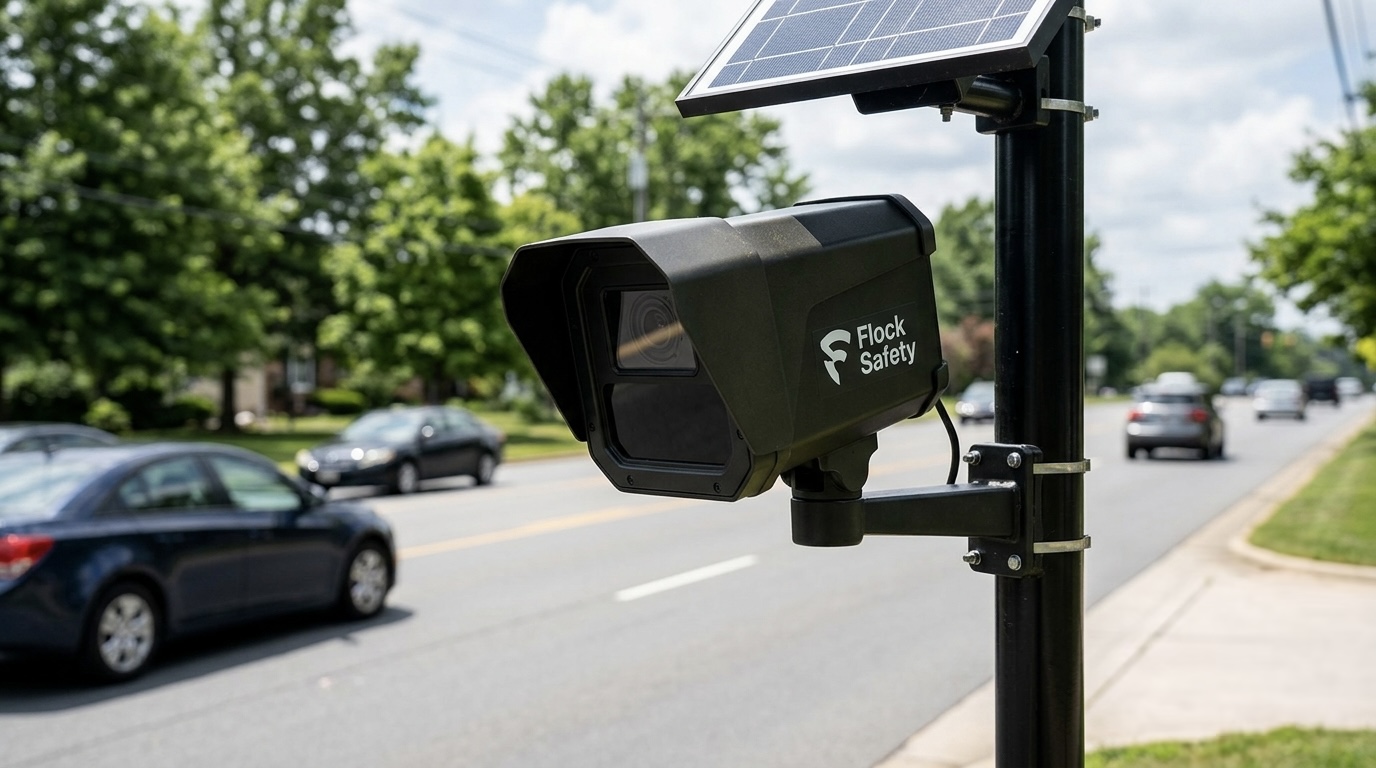
Flock Safety's cameras photograph every vehicle that passes, log the plate, the make, the color, the time, and the location, and pour it all into a searchable national database that thousands of police agencies can query. The company says its cameras sit in more than 6,000 communities in every state except Alaska, and independent researchers running the DeFlock mapping project have located roughly 80,000 of them. (TechCrunch) A federal judge who looked at all this in January wrote that the constitutional question, whether this amounts to too much surveillance, has an answer of "not today." Hold on to that phrase, because it is doing a lot of work, and I will come back to it.
I write about privacy for a living, sort of. By day I do HR in manufacturing, and nights and weekends I build iOS apps whose entire pitch is that your data stays on your phone. So when the biggest privacy fight in the country stops being about apps and starts being about physical cameras bolted to poles in ordinary suburbs, I pay attention.
A search engine for where you've been
The thing to understand about Flock is that the camera is not the product. The database is. Any individual camera just photographs passing cars. What made Flock a company reportedly valued around $7.5 billion is the network effect: a detective in one town can run a plate against cameras in thousands of other towns through Flock's National Lookup tool. Flock did not really build a camera company. It built a search engine for where you have been.
That is also the company's honest defense, and it deserves a fair hearing. Stolen cars get found. Amber Alerts get resolved. Flock says its technology supported over one million investigations in 2025, and police departments from Richmond to Los Angeles credit it with clearing cases that would have gone cold. (Newsweek) If your car was stolen tonight, you would want your city on the network. None of the critics seriously dispute that the system catches criminals. The dispute is about what else it catches, which is everyone.
The case that changed the argument
For a long time the privacy objection was theoretical. You could say "this could be abused" and a police chief could say "but it isn't," and the council would renew the contract. Then Texas happened.
In May 2025, a sheriff's deputy in Johnson County, Texas ran a search across the Flock network looking for a woman. Not a suspect in a robbery, not a missing child. A woman whose partner had reported her to police two weeks after she self-managed an abortion. The first search hit 17,684 cameras. The expanded search covered 6,809 networks and 83,345 cameras across multiple states, a month of data, and the logged reason for both queries read, in the deputy's own words, "had an abortion, search for female." (EFF)
Sheriff Adam King told reporters the search was a welfare check, that "her family was worried that she was going to bleed to death," and Flock's CEO Garrett Langley backed him publicly, saying "this is everything's working as it should be." Then the Electronic Frontier Foundation got the documents. The case was categorized internally as a death investigation of a "non-viable fetus." Detectives seized a FedEx envelope containing the medication, read her text messages, and consulted the district attorney about charges before being told none were statutorily available. The lead investigator's affidavit never mentioned blood. The bitter coda is that the woman later reported domestic violence by the same partner who reported her, and he is the one now facing charges.
Two things make this case the hinge of the whole national fight. First, it showed that a single deputy in one Texas county could search cameras in states where abortion is legal, meaning your state's laws protect you only until someone else's state runs a query. Second, it showed that the audit logs, the safeguard Flock points to constantly, recorded the abuse perfectly and prevented none of it. A log is a diary, not a lock.
And it was not a one-off. Audit logs obtained through a records request in Danville, Illinois showed more than 4,000 immigration-related lookups on the network between June 2024 and May 2025, tagged with terms like "ICE+ERO" and "ICE WARRANT," even though ICE had no agreement with Flock and Illinois law flatly prohibits using plate readers for immigration enforcement. (Straight Arrow News) Local officers were running the searches informally on federal agents' behalf. Flock's own policy forbade it. It happened anyway, thousands of times.
Bolt cutters and city councils
The backlash now runs on two tracks, one legal and one very much not.
The illegal track is people physically destroying the cameras. TechCrunch documented cases across California, Connecticut, Illinois, Virginia, and Oregon, where six cameras were cut down and one was spray-painted with a message I will paraphrase as unfriendly. In Suffolk, Virginia one man was charged with destroying 13 of them. To be clear, that is vandalism and people are being prosecuted for it, and it is also a signal politicians can read: normal people are angry enough about a public safety tool to risk a felony to remove it.
The track that actually matters is the boring one. Cities are quitting. Flock contracts have now been canceled or not renewed in 23 states. (Washington Examiner) El Cerrito, California switched its cameras off in June, with Mayor Pro Tem Rebecca Saltzman saying plainly, "ultimately my biggest concern is the federal government could access the data." Appleton, Wisconsin's mayor said concerns about Flock's system "have eroded our trust." Bloomington, Indiana killed a $50,000 agreement after residents organized. (Newsweek) The list of deactivated jurisdictions on the DeFlock tracker keeps growing, and the LAPD, one of Flock's marquee customers, is renegotiating its contract over what it called serious civil liberties concerns. (Fortune)
Washington noticed. The House Oversight Committee opened a formal investigation into Flock after the Texas case. And in late July, Rep. Thomas Massie announced a bill to withhold federal money from municipalities and police departments "that deploy Flock (and other style) cameras to surveil law abiding citizens." Flock's response was that the bill would have "real consequences for public safety" and that Congress should write safeguards instead of defunding the tech. Massie's bill probably does not pass this Congress. That is not really its job. Its job is to make Flock a named issue with a constituency on both the left and the right, and it has already done that.
Not today, but maybe soon
Which brings me back to that phrase. In January, federal judge Mark Davis ruled on a Fourth Amendment challenge to Norfolk, Virginia's 176 Flock cameras, a lawsuit brought by the Institute for Justice. He held the system constitutional, for now, because snapshots taken 40 to 50 minutes apart with 21-day retention did not add up to reconstructing someone's whole life. But he warned in his 51-page opinion that the technology "could become too intrusive" as networks grow, and answered the big question with "at least in Norfolk, Virginia, the answer is: not today." (WHRO) The plaintiffs are appealing. Every camera Flock installs makes the "not today" answer harder to give with a straight face, because the gaps in coverage were the entire basis of the ruling. Flock's growth strategy and its legal defense are pointed in opposite directions.
So where does this go? My honest read: the cameras are not disappearing. Too many departments rely on them and the crime-solving wins are real. What is ending is the era when a network this large ran on vendor policy and pinky promises. Expect state laws restricting cross-state and immigration queries, Illinois and Oregon are already moving, expect warrant requirements for historical lookups in some states, and expect the appellate courts to eventually decide that a big enough camera network is a search under the Fourth Amendment. The Supreme Court said something similar about phone location data in Carpenter. Plate networks are next in line.
Why this matters here
I build privacy-first apps, so I will not pretend I am neutral, but the lesson I keep taking from this story is not really about cameras. It is that "trust us, there's a policy" failed in public, repeatedly, with logs to prove it. That is exactly why everything in my own apps stays on the device where no query from three states away can reach it. There is no policy protecting your journal in DayCast. There is just no server to search. The Flock story is the strongest argument for that architecture I have seen all year, and nobody at Flock intended to make it.
A few caveats. The Johnson County account reflects EFF's reporting from obtained documents; the sheriff disputes the characterization and no charges were filed against the woman. Massie's bill text had not been formally introduced as of this writing. Camera counts come from DeFlock's crowdsourced map and Flock's own public statements, and the two do not fully agree. You can see what this studio builds, private by design, at jcmobileappstudio.com/apps.
Comments
Be kind and stay on topic. Comments are reviewed before they appear.