Quick note before we start. This is general health information, not medical advice. Decisions about vaccines are personal, and the right call for you is a conversation to have with your own clinician. What follows is just a plain reading of what one study found. The interesting part is not really about the flu. It is about a gap between what people are willing to do and what they actually get offered.
What the study actually did
A team led by the University of California, Riverside surveyed 3,285 adult patients across 10 emergency departments in 8 U.S. cities, between April and December 2024. The results were published in the Journal of Emergency Medicine. Instead of guessing what patients think about vaccines, the researchers simply went to where people already were, the waiting rooms and bays of busy emergency departments, and asked them directly (UC Riverside).
That setting matters. Emergency departments see a wide slice of the public, including a lot of people who do not have a regular doctor and do not pass through the usual places a flu shot gets offered. So the patients in this study are not a tidy, already-engaged group. They are closer to the general population, including the parts of it that often get missed.
Almost everyone had heard of it
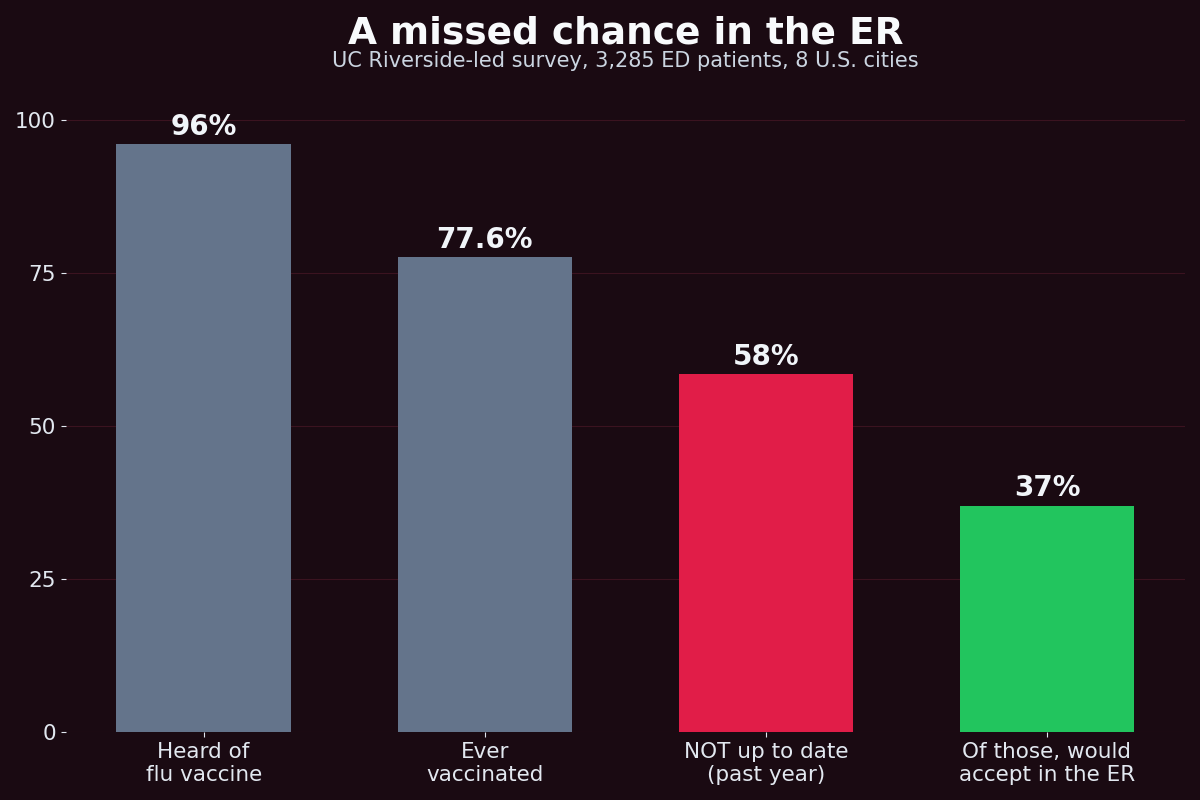
Awareness was close to universal. 96 percent of the patients had heard of the influenza vaccine, and 77.6 percent reported getting a flu shot at some point in their lives. So this is not a story about people who have never encountered the idea or who reject it outright. The vast majority know what a flu shot is and most have had one before.
The gap shows up when you ask about timing. 58.4 percent had not received a flu vaccine in the past year, which means they were not up to date with current recommendations. Flu protection fades and the virus shifts, so a shot from a few years ago does not count for this season. A clear majority of the people surveyed had simply fallen behind.
The hopeful number
Here is the finding that makes this study worth talking about. Among the patients who were not up to date, 37 percent said they would accept a flu shot if it were offered during their emergency department visit. More than a third. Not after a campaign, not after a lecture, just if someone walked over and offered.
That reframes the whole thing. We often picture vaccination gaps as a wall of refusal, people digging in and saying no. This data points somewhere gentler. A big share of the people who are behind are not refusing at all. They are just never being asked, in a place and a moment where they would say yes.
Who gets left behind
The study also found that the gaps were not spread evenly. Patients without a primary care provider were more than twice as likely to be behind on flu vaccination. Lower rates also showed up among patients without insurance and among African American patients (Mirage News).
That pattern fits the logic of the whole study. If you do not have a regular doctor, you do not get the routine nudge, the reminder text, the offer at a checkup. For a lot of people, the emergency department is their main point of contact with the health system. The researchers suggest that is exactly why EDs could play a real role in closing these gaps, especially for medically underserved patients who fall through the usual cracks.
Why the ER does not just do this already
If patients are willing and the need is clear, why is this not already routine? The honest answer is that emergency departments are built to handle emergencies, not to run a vaccine clinic. They are busy, short-staffed, and organized around getting people stabilized and moving. Adding a vaccination step means new workflow, new supplies, and someone whose job is to make the offer. None of that is free.
So the barrier here is not stubborn patients. It is logistics and staffing. That is actually encouraging, because workflow problems are the kind you can solve with planning and resources, in a way that changing minds is not. The willingness is already in the room. The question is whether the system can be set up to meet it.
If you find small health and behavior studies interesting, you might also like what we wrote about the summer solstice and your sleep and about mental health at work. And just to repeat the point from the top, this is general information and not medical advice. Whether a flu shot is right for you, and when, is a question for your own clinician. You can see what this studio builds at jcmobileappstudio.com.
Comments
Be kind and stay on topic. Comments are reviewed before they appear.