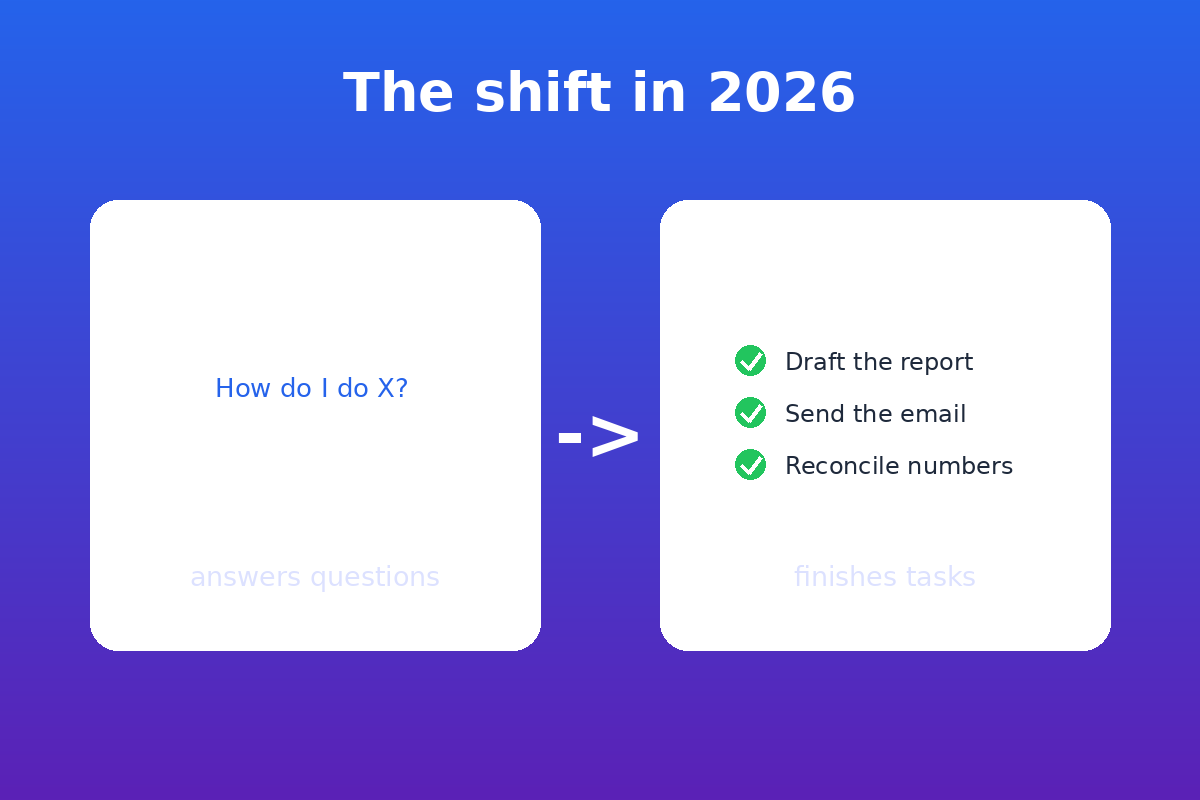
For three years, the AI conversation was about answers. You typed a question, you got a paragraph back, and the magic was that the paragraph was good. The shift in 2026 is from answering to doing. The tools getting attention now do not just describe how to book the trip, file the report, or fix the code, they go and do a version of it, then hand you the result to check. The industry word for this is agentic, which is a fancy way of saying the software takes actions on your behalf inside real tools.
Why this is a bigger deal than a smarter chatbot
A chatbot that answers well saves you a search. An agent that completes a task saves you the task. That is a different category of value, and it is why the companies pulling ahead are not the ones with the flashiest benchmark scores, they are the ones building repeatable workflows for ordinary jobs, drafting and sending, researching and summarizing, triaging support, reconciling numbers. The winners look less like a genius in a box and more like a reliable junior employee who never sleeps and occasionally needs a second set of eyes.
That last part matters. Agents are useful and also confidently wrong sometimes, which means the sane way to use them in 2026 is supervised, like a capable coworker whose drafts you still read before they go out. The teams getting real value treat AI as a worker to manage, not a oracle to trust. The teams getting burned are the ones who skipped the review step.
Compute is becoming a national resource
Here is the macro signal under the product news. Governments have started treating AI compute, the raw chips and data centers that train and run these systems, like infrastructure worth negotiating over. The pattern this year includes the United States and Japan expanding their AI and tech cooperation, and the United Kingdom and Canada signing a compute-sharing arrangement. When countries start trading access to GPUs the way they trade access to energy, that tells you the bottleneck has moved. The hard part is no longer the idea, it is the electricity and the silicon to run it at scale.
The small headlines that show the direction
You can see the same trend in this week's minor news. ChatGPT finally added pinned chats, so you can keep the conversations you reuse at the top, a tiny feature that only makes sense if people are returning to the same assistant for ongoing work rather than one-off questions. Apple is reportedly opening Siri to Claude and Gemini as selectable engines, another sign that the interface and the model are splitting apart. The assistant is becoming a front door, and you get to choose which brain answers.
Not every headline is rosy. Google is finishing its multi-year removal of Manifest V2 from Chrome in the upcoming releases, which fully retires the old extension rules that classic ad blockers like the original uBlock Origin relied on. Google frames it as security, critics see it as weakening ad blocking on the world's most popular browser. It is a useful reminder that the same platforms shipping helpful AI also control the rules of the road, and they change those rules to suit themselves. If your browsing depends on an extension, this is the year to check whether it has moved to the new rules or whether it is time to switch browsers.
What this means for a normal person
You do not need to chase any of this. But a few habits pay off in 2026. Start using one assistant for real, repeated tasks instead of treating it as a novelty, because the value shows up in the workflow, not the demo. Keep the review step, always read what an agent produces before you act on it. And pay a little attention to the plumbing, which browser, which defaults, which extensions, because the companies are quietly rewriting it underneath you. The flashy demos will keep coming. The real change is that software is starting to do the boring parts, and the skill worth building is knowing how to check its work.
The honest bottom line
The story of 2026 is not a single breakthrough, it is a category change. AI stopped being a thing you ask and started being a thing you delegate to. That is more useful and more risky at the same time, which is exactly why the boring discipline, supervise it, verify it, own the result, is the whole game.
For the privacy angle on assistants doing more on your behalf, see the privacy question in the new Siri, and for this week's Apple-specific roadmap see Gurman's Tuesday report. You can see what this studio builds at jcmobileappstudio.com.
Comments
Be kind and stay on topic. Comments are reviewed before they appear.