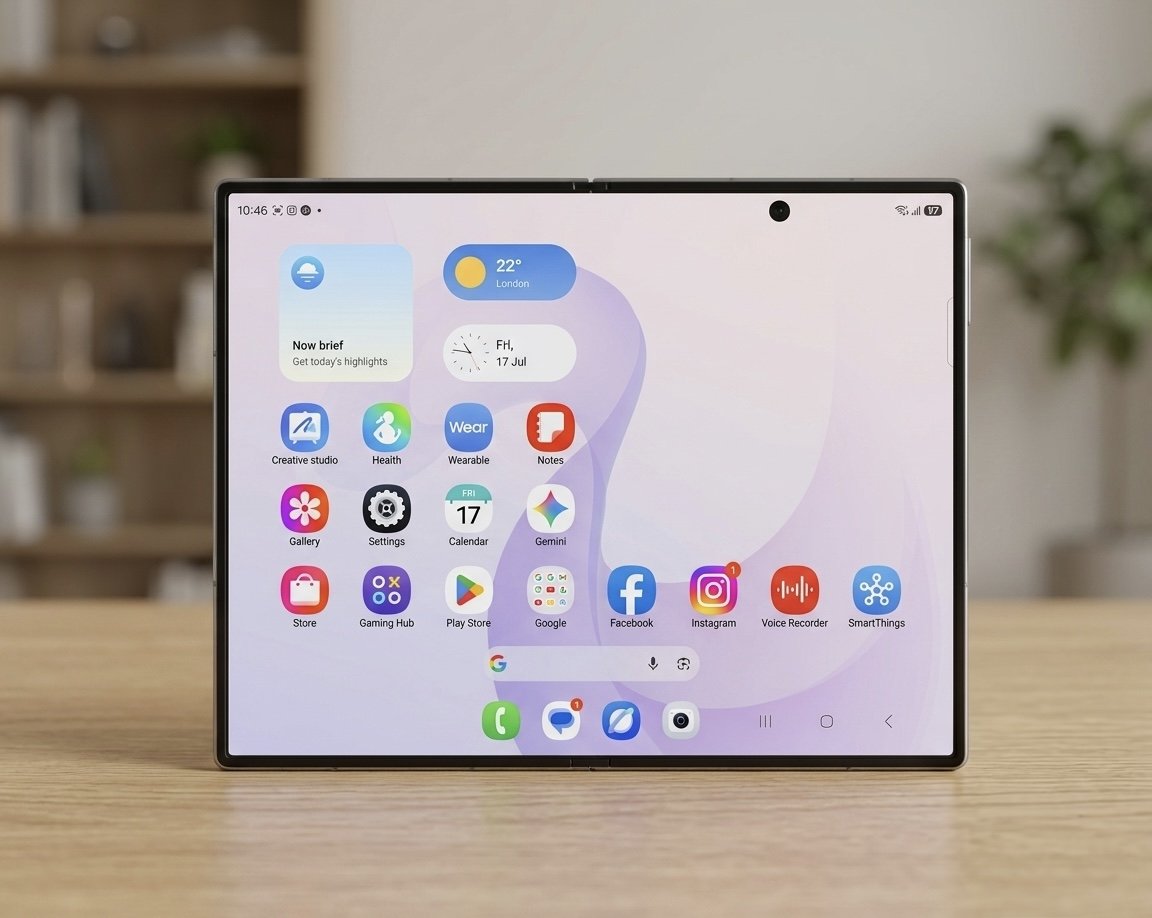
What eight generations actually bought
It is easy to forget how bad the beginning was. The original Galaxy Fold in 2019 broke in reviewers' hands within days, some units because people peeled off what looked like a screen protector and was actually the screen, and Samsung had to delay the launch and re-engineer the thing before it ever properly went on sale. That phone became a punchline, and the punchline stuck to the whole category for years. Fragile hinge, visible crease, a gap when folded, and a price north of anything else on the shelf. Every Fold since has been Samsung publicly sanding down that list, one generation at a time, while most of the industry watched from a safe distance.
The Z Fold8 is where the sanding finally shows. Reviewers keep landing on some version of the same sentence, the crease almost disappears when you are looking at content, even if your fingertip can still find it. Tom's Guide credits the new Flex Titanium hinge construction, and notes the anti-reflective coating genuinely tames outdoor glare in a way the Fold7 didn't. The rest of the hardware has quietly caught up to normal-phone standards too: 201 grams, which makes it the lightest book-style foldable yet and lighter than some candybar flagships, 4.5mm thin per side when open, a 4,800mAh silicon carbon battery that ran over twelve hours in Tom's Guide's 5G web test, and 45W charging that refills 70 percent in half an hour. (Tom's Guide)
It is not a finished argument, and honest reviews say so. There is still no telephoto lens, which stings at $1,899. The IP48 rating means it will survive water but Samsung still cannot promise it against dust, the oldest foldable weakness there is. There is no S Pen support this generation, and Android app developers still have not all done the work, Tom's Guide found plenty of apps that render as a stretched-out phone app on the beautiful 7.6-inch inner screen. Remember that last one, it comes back at the end of this post. (SamMobile)
Why I keep buying these things
People who do not use foldables tend to assume the appeal is the party trick. It isn't, or at least it stops being the trick after the first week. It is what the shape does to how you use the phone. Games that feel cramped on a slab get room to breathe on a near-square 7.6-inch screen. Real multitasking, not the polite kind, Tom's Guide ran three apps in split screen on the Fold8 without lag, and that is the difference between glancing at a reference while you write and juggling app switches until you lose your train of thought. A foldable closed is a phone. A foldable open is the smallest screen that actually feels big. That is the whole pitch, and once it clicks for you, a regular phone starts feeling like a keyhole.
The market has apparently started agreeing. Fold7 demand grew roughly 50 percent over its predecessor, and 9to5Mac reports Fold8 demand running about three times higher than the Fold7's initial numbers. Seven years of "who is this even for" and then, rather suddenly, a line. (9to5Mac)
Apple's patience, called by its right name
Which brings us to the iPhone Ultra, expected next month alongside the iPhone 18 Pro line, with reporting that suggests Apple is targeting something like a quarter of the entire foldable market in year one. The timing looks brilliant, and it is, but be precise about what the brilliance was. Apple did not solve the crease. Apple waited while Samsung spent seven years and eight generations solving it in public, absorbing every broken review unit and every "still creased" headline along the way, and by some reporting Apple even lent its own engineers to the display supply chain effort, since both companies ultimately buy panels from the same places. Then, the moment the technology matured and the demand curve bent upward, Apple arrived.
I do not say that as an insult. Sitting out a category until it is ready is a discipline almost no company has, and an early Apple foldable with a 2019-Fold-style failure would have been a vastly bigger story than Samsung's stumbles ever were, because Apple's brand premium is built on things just working. But the fan-blog framing where Apple "finally shows Samsung how it's done" next month deserves pushback before it starts. Whatever the iPhone Ultra turns out to be, it will be standing on seven years of someone else's homework. Both things can be true: smart strategy, borrowed courage.
The one number I'd watch
Nobody outside Cupertino knows the iPhone Ultra's price, and every figure floating around right now is a guess. But the Fold8 gives you the honest yardstick: $1,899 is what a mature, eighth-generation foldable costs from the company with the most practice building them. Apple does not usually undercut Samsung on anything, and first-generation Apple hardware in a new category rarely arrives cheap. If the Ultra lands meaningfully under that number, it is a statement of intent about owning this category fast. If it lands well over it, Apple is betting the brand can carry a price the category has never supported. Either way, the gap between those two numbers will say more than the keynote does.
Why this matters here
Remember the stretched-apps problem from the top of this post? That is not just Samsung's headache, it is about to become mine, and I am honestly looking forward to it. I build iPhone and iPad apps, planners and trackers and note tools, exactly the kinds of apps that either shine on a folding screen or embarrass themselves on one. The moment Apple's foldable is real, every iOS developer inherits a new question: what does your app do when the screen changes shape mid-use? iPad support means my layouts already know how to be big. They do not yet know how to become big, mid-task, with a fold line down the middle. I would rather find those answers early than late, so the day I can put my own apps on a folding screen, I will be doing exactly that, and writing about what breaks. The Fold8 review lands here after August 7. Consider this post the before picture.
iPhone Ultra details in this post are reporting and supply-chain sourcing, not Apple announcements, and pricing is unknown. Fold8 figures come from the linked reviews and Samsung's published specs. You can see what this studio builds at jcmobileappstudio.com/apps.
Comments
Be kind and stay on topic. Comments are reviewed before they appear.