Quick disclaimer, and it matters here. This is general information drawn from the FDA and CDC notices, not medical advice. If you are sick or worried about an exposure, contact a clinician or your local health department. Nothing below replaces that.
What was recalled
Clover Hill Dairy of Mechanicsville, Maryland is recalling its soft ricotta and requeson cheese, a fresh, mild cheese similar to ricotta, because it may be contaminated with Listeria monocytogenes. The recall has been expanded to cover the affected products the facility made, after testing by New York's agriculture department found Listeria in an unopened container and whole genome sequencing matched it to the outbreak strain. (FDA)
The tricky part: it was sold under many names
The cheese was distributed from May 4 through May 30, 2026 in North Carolina, New York, Virginia, Maryland, New Jersey, and Washington, DC. It came in 10, 12, and 14 ounce clamshell containers, and bulk cheese was repackaged under several distributor brands, including KESSO, QUESOS LA RICURA, IZALCO, DE MI PUEBLO, and RIO LINDO. One detail that helps you check: look for plant number 24-128 on the label. If you have a soft ricotta or requeson cheese from this window and you are not sure, the safe move is to treat it as suspect. (Consumer Reports)
Why Listeria gets its own headline
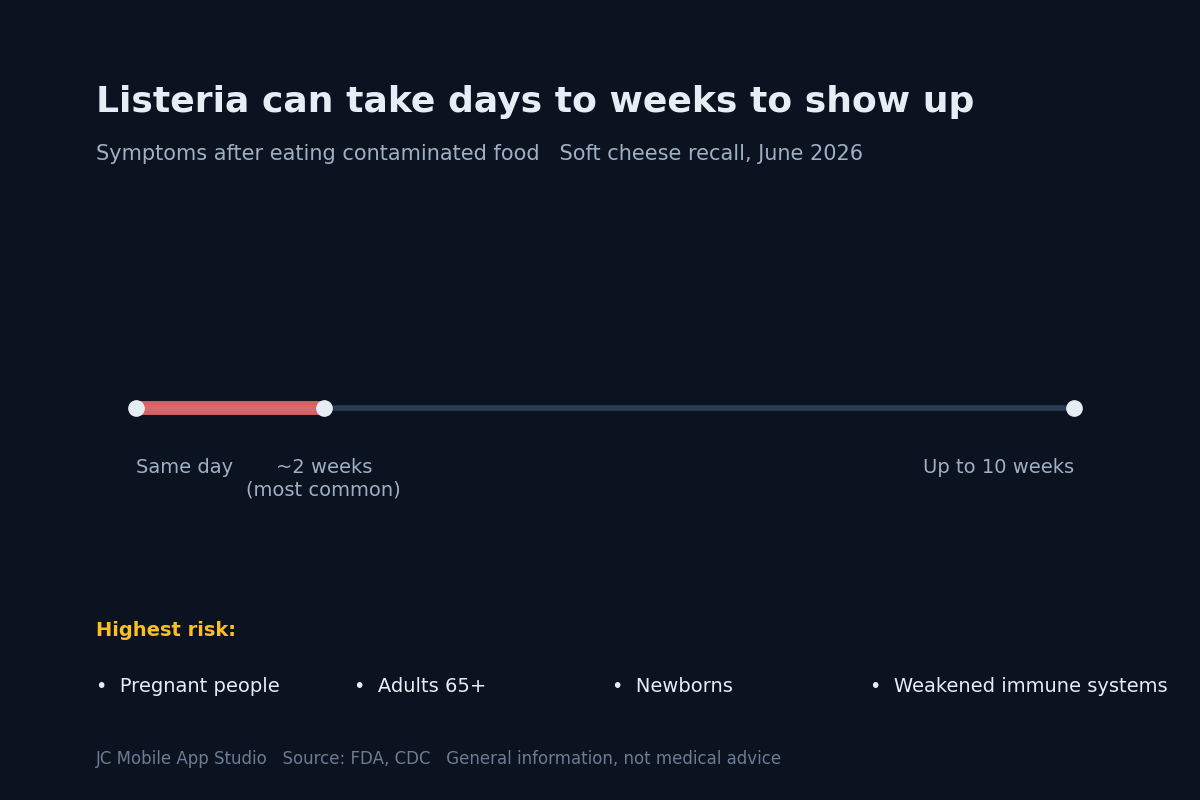
Most foodborne bugs make you sick within a day or two and then pass. Listeria is different on two counts. It is slow: symptoms usually start within about two weeks of eating contaminated food, but can appear the same day or as late as ten weeks later, which is why people often cannot connect the illness back to a specific meal. And it is serious for certain groups. Mild cases can look like a stomach bug, with fever, muscle aches, nausea, tiredness, vomiting, and diarrhea. The severe form, listeriosis, can bring headache, stiff neck, confusion, loss of balance, and convulsions, and it can be fatal. (FDA)
Who should be most careful
Listeria poses the greatest danger to pregnant people, where it can cause miscarriage and stillbirth, to newborns, to adults 65 and older, and to anyone with a weakened immune system. If you or someone you cook for is in one of those groups, this is the recall to take literally. For a healthy adult the risk is lower, but it is not zero, and the simplest response costs you a few dollars of cheese.
What to do, in order
First, if you have any of the recalled cheese, do not taste it to check, just throw it out or return it. Second, clean your refrigerator, because Listeria is one of the few bugs that can actually grow at fridge temperatures and spread to other foods and surfaces. Wipe down shelves and drawers with hot soapy water. Third, watch for symptoms over the next several weeks, not just the next few days, especially if you are in a higher-risk group, and seek medical care if they appear and mention the possible exposure. Fourth, if you are pregnant or caring for someone vulnerable and think you ate it, call a clinician even without symptoms and ask what they recommend.
The boring habit that prevents most of this
Recalls are unpredictable, but a couple of small habits quietly lower your odds. Soft, fresh cheeses made from unpasteurized milk are a recurring source of Listeria, so checking the label for pasteurized milk is a cheap edge, particularly during pregnancy. And keeping your fridge at or below 40 degrees slows Listeria down even when something slips through. None of it is dramatic. Most food safety is just dull habits that you are glad you had.
That is the soft cheese recall as of June 18, 2026. The brands and dates above come straight from the FDA and CDC notices, and recall lists can grow, so if this is relevant to your home it is worth checking the FDA page directly for the latest. General information, not medical advice. You can see what this studio builds at jcmobileappstudio.com.
Comments
Be kind and stay on topic. Comments are reviewed before they appear.