Quick framing first. This is an explainer based on Apple's own descriptions and on reporting, not a leak and not a scare piece. The point is to understand the architecture, because the architecture is the whole story. Once you see how the new Siri decides where to send a request, the privacy question gets a lot clearer, and a lot less black and white.
What Apple confirmed
At WWDC 2026 Apple rebuilt Siri around what it calls Siri AI, and reporting has filled in what is underneath. The assistant is powered by a custom version of Google's Gemini, a very large model, and the heaviest reasoning runs on Nvidia's Blackwell B200 GPUs hosted in Google's cloud. Apple and Google first announced a multi-year AI collaboration back in January, but this is the first time Apple has effectively confirmed that some Apple Intelligence features lean on Nvidia hardware rather than Apple's own silicon. (CNBC)
Why hand the crown jewels to a rival's model? Reportedly because Apple tried to get a modified Gemini running on its own server hardware and found it too slow. Speed matters for an assistant you talk to, so Apple made the pragmatic call: use the fast path that works, and wrap it in as much privacy engineering as possible. (9to5Mac)
The three tiers, in plain terms
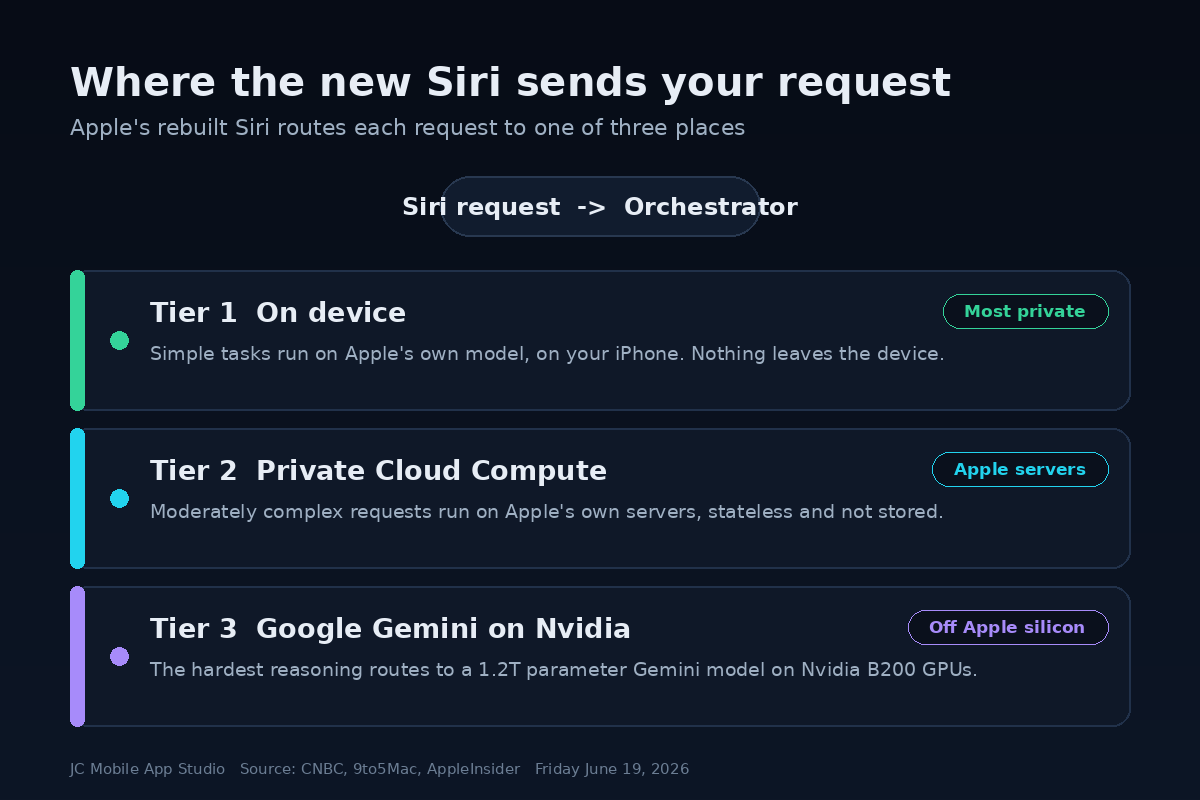
Here is the part that actually matters for privacy. Every request you make does not go to the same place. An orchestrator looks at how hard the request is and routes it to one of three tiers.
Tier 1, on your device. Simple things, setting a timer, a quick rewrite, basic on-screen awareness, run on Apple's own small model right on your iPhone. Nothing leaves the phone. This is the most private tier, and it is where Apple wants as much as possible to happen.
Tier 2, Private Cloud Compute. Moderately complex requests go to Apple's own servers, but a special kind. Private Cloud Compute is designed to be stateless, it processes your request and keeps nothing, it does not log your data, and Apple has published the design so researchers can check the claims. It is still the cloud, but it is Apple's cloud built to forget you.
Tier 3, the full Gemini model on Nvidia GPUs. The hardest reasoning, the multi-step questions and the deep search across your stuff, routes to the big 1.2 trillion parameter Gemini model running on Nvidia Blackwell chips in Google's cloud. This is the tier that leaves Apple's hardware entirely. (AppleInsider)
So is it still private?
The honest answer is, it depends which tier you land in, and Apple has gone to real lengths to protect even Tier 3. Apple says the Gemini tier runs inside its Private Cloud Compute protections, meaning the model runs on hardware configured so that even the host, Google in this case, cannot see the contents of your request, and the data is not retained or used to train anyone's model. If that holds up to inspection, it is a genuinely different deal than typing the same question into a public chatbot.
But layered is not the same as simple, and the marketing got simpler than the truth. Apple differentiates itself by collecting less than a web-based assistant and by keeping a lot on the device, which is real. It is also now true that your most complex Siri requests can be processed by a Google model on Nvidia silicon. Both statements are accurate at the same time. The useful mental model is not "Apple equals private, everyone else equals not." It is "Apple tries to keep your request on the most private tier that can still answer it."
Why this was probably inevitable
It is easy to read this as Apple abandoning its principles, but the more boring reading is more accurate. Truly capable assistants need enormous models, enormous models need enormous compute, and building that compute from scratch on your own chips, fast enough to feel instant, is brutal and slow. Apple bet that it could buy the capability from Google and Nvidia now, wrap it in its own privacy plumbing, and keep moving more of the work back onto the device over time as its own models and chips catch up. That is a trade, not a surrender.
What it means for you, practically
For most people, day to day, the experience is just a much better Siri, and the routing is invisible. If you care about privacy, the practical takeaways are small but real. The most sensitive things you can do on a phone, the quick on-device actions, still happen on device. The cloud tiers are built to be stateless and unreadable, which is better than the typical chatbot, but they are still off your phone, so the old instinct of not pasting your most sensitive secrets into any assistant still applies. And the broader lesson holds: privacy is not a single switch, it is an architecture, and it is worth understanding the architecture of anything you let read your messages.
That belief is a big part of why this studio builds the way it does. The apps here lean on on-device processing and ask for as little as possible, because the most private data is the data that never leaves your phone in the first place. The new Siri is a fascinating, layered compromise. It is also a good reminder of why the on-device default is worth defending.
That is the new Siri as of June 19, 2026, a Google model on Nvidia chips, wrapped in Apple's privacy engineering, with a lot still kept on the device. For background, I wrote about what on-device AI really means, the privacy question in the new Siri, and how Apple's foundation models work. You can see what this studio builds at jcmobileappstudio.com.
Comments
Be kind and stay on topic. Comments are reviewed before they appear.