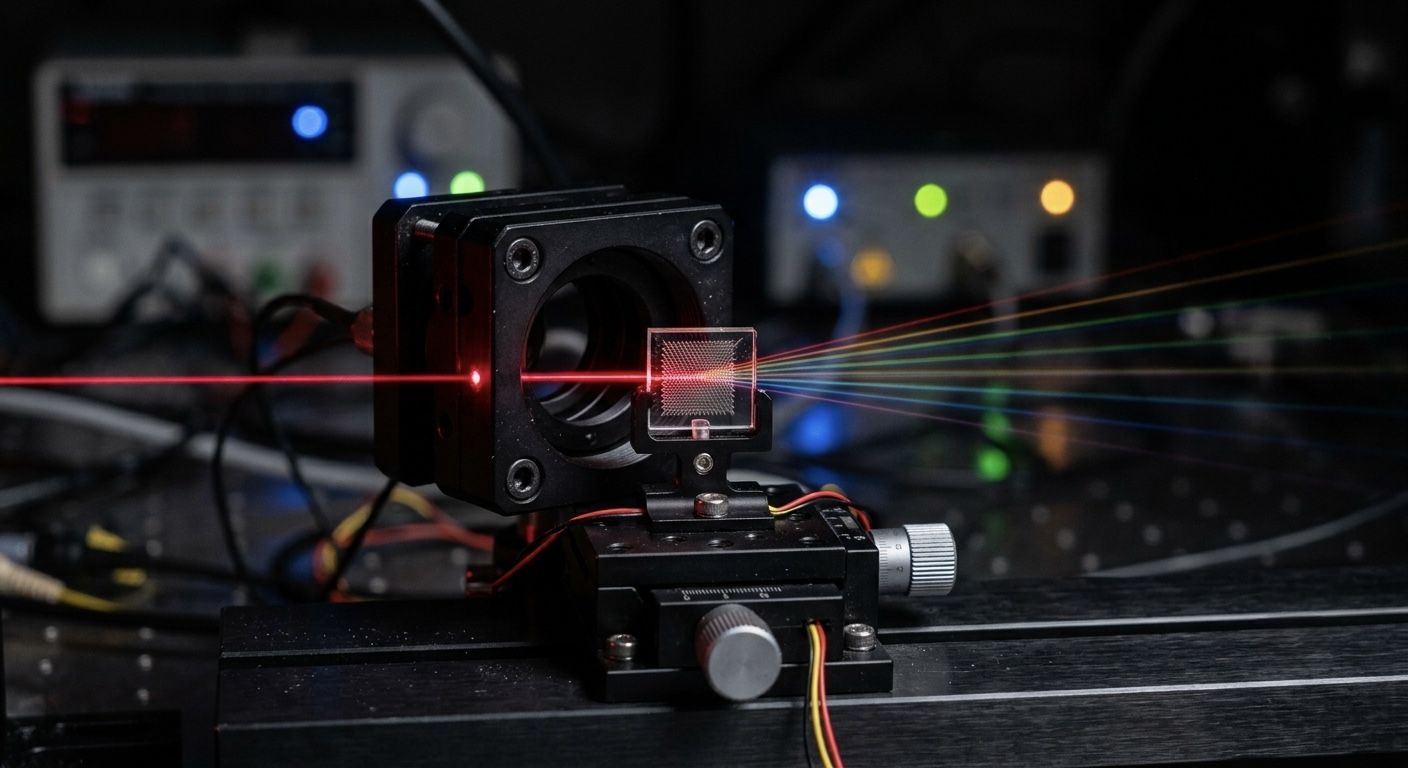
Most of the time when I write about a "breakthrough," it is really an incremental step dressed up for a headline. This one is not that. Researchers from École Polytechnique, Collège de France, and the Helmholtz Zentrum Dresden Rossendorf just built the first all optical photonic time crystal, and it is a genuinely new kind of material.
Here is the plain language version. A normal photonic crystal is a material with a repeating structure in space, the pattern of atoms or layers is what shapes how light moves through it. A photonic time crystal does the same trick, but in time instead of space. Its optical properties, how reflective it is, how it bends or traps light, change on a repeating cycle, over and over, incredibly fast.
The team built theirs out of a plasmonic metamaterial, tiny gold structures measured in micrometers, sitting on top of a semiconductor layer made from indium antimonide. When they hit it with terahertz laser pulses, the light triggers something called surface plasmons, which are basically waves of electrons moving along the material's surface that trap the light against it. That trapping is what lets the reflectivity of the material flip dramatically, in picoseconds. A picosecond is one trillionth of a second. For comparison, light itself only travels about a third of a millimeter in that time.
Why terahertz specifically. Terahertz light sits in an awkward gap between radio waves and infrared light, faster than anything our electronics can natively handle, but slower than the light your fiber internet already uses. It has been a frustrating band for engineers for years, hard to generate, hard to control, even though it is genuinely useful for imaging and high bandwidth communication. Lead author Tingwen Guo put it well: "By extending photonic crystals from space to time, we open a new dimension for light control, and a novel path toward amplification and lasing. That could be a game changer for optical technologies at terahertz frequencies and beyond."
So where does your phone come into this. Nowhere yet, and I want to be honest about that instead of doing the thing tech blogs do where a university lab result gets described like it ships next spring. This is a single demonstrated device, in a lab, at terahertz frequencies, not visible light, and not anywhere near a form factor you could put in a chip package. The realistic path, if there is one, runs through things like ultrafast optical computing, next generation telecom hardware, and highly tunable terahertz lasers for medical imaging, long before it touches a consumer device.
But here is why I still think it is worth paying attention to if you care about where on-device AI is headed. Every neural engine improvement Apple and Qualcomm have shipped over the last several years has been about doing more inference locally, on your device, without sending your data anywhere, faster and using less battery. The physical bottleneck on that trend is always the same: electronic switching has speed and heat limits that are getting harder to push past. Optical computing, using light instead of electrons to move and process information, is one of the more credible long term answers to that wall, because light does not generate resistive heat the way electron flow through a wire does, and it can, in principle, switch orders of magnitude faster. A material that can flip its own optical state on demand, reliably, is one of the missing pieces for building actual optical logic, not just optical transport.
None of that means your 2031 iPhone has a photonic time crystal in it. It means the people who spend their careers thinking about what comes after silicon just got a real, publishable, peer reviewed tool to work with, instead of a theoretical proposal. That is a slower story than "scientists invent light computer," but it is the true one, and it is usually the true, slower story that actually pans out.
I will keep an eye on this one. If terahertz photonic switching moves from a single lab demonstration to something reproducible at scale, that is the point where it stops being a physics curiosity and starts being a roadmap item.
Sources: ScienceDaily, Aalto University, and Phys.org. You can see what this studio builds at jcmobileappstudio.com/apps.
Comments
Be kind and stay on topic. Comments are reviewed before they appear.