The summer everyone wants to put the phone down
It comes back every warm season like cicadas. Right on cue, the "dumbphone" pieces returned, with people flipping their iPhones to grayscale, deleting the social apps, or switching to a launcher that shows nothing but a list of words. The framing is that the device itself is the villain and the fix is to make it as boring as possible so you finally close it. (Newsweek)
I get the impulse. I also think the grayscale trick is a little bit of a magician's move, where you fix the color and feel like you fixed the problem. The color was never the point. The point is that a lot of what lives on your phone was built to be hard to put down, and turning the screen gray does not change who designed it that way or why.
The number that actually got me
A report out this spring put a real shape on the thing we all feel. Aura looked at more than a million and a half days of device activity from close to thirty thousand kids and found that screen time does not drift up in summer, it jumps. Younger kids, ages seven to twelve, add over four hours a week the moment school lets out, about thirty percent more than the school year. Roughly one in three kids scored in the low range of a digital wellbeing index during June through August, a range the report links to worse sleep and higher stress, and more than one in ten were still on a device at midnight. (Aura)
I do not have kids. I have two dogs and a day job in HR, where I spend a lot of time watching how systems shape behavior whether people mean them to or not. So the stat that stuck with me was not about kids at all. It was the same one the parents flagged: sixty-three percent said infinite scroll makes it harder to set any boundary at all. That is not a willpower story. That is a design story, and I am on the design side of the table.
The awkward part is that I make the thing
Here is the honest tension. I write plain-language pieces telling people to guard their attention, and then I go build software that lives on the exact device I am telling you to put down. If I wanted to be smug about it I would say my apps are different. But that is too easy, and you would be right to roll your eyes.
So let me be specific instead. There is a real line between a tool and a trap, and it is not about whether something is on a screen. A tool has a bottom. You open it, you do the thing, and it lets you leave. A trap does not have a bottom on purpose, because the business only works if you never reach the end. A feed that refills forever, an autoplay that starts the next thing before you decide to want it, a badge count invented to pull you back. None of that is an accident. Someone chose it in a meeting.
A tool versus a trap
The apps I build are boring in the way a good tool is boring. You open the planner, you write down the thing, you close it. The subscription tracker exists to be checked once and then ignored for a month. There is no feed to fall into, no ads sold against your time, no reason for me to want you staring at it longer than the task takes. That is not virtue, it is just a different deal. I would rather build the kind of thing you reach for and then set down than the kind you have to install a second app to protect yourself from.
That is also why so much of the lineup runs on-device. When nothing has to leave your phone, there is no server on the other end getting more useful the more you feed it, which means there is nothing quietly rooting for you to keep scrolling. Privacy and attention turn out to be the same fight wearing two jackets.
What the dogs taught me
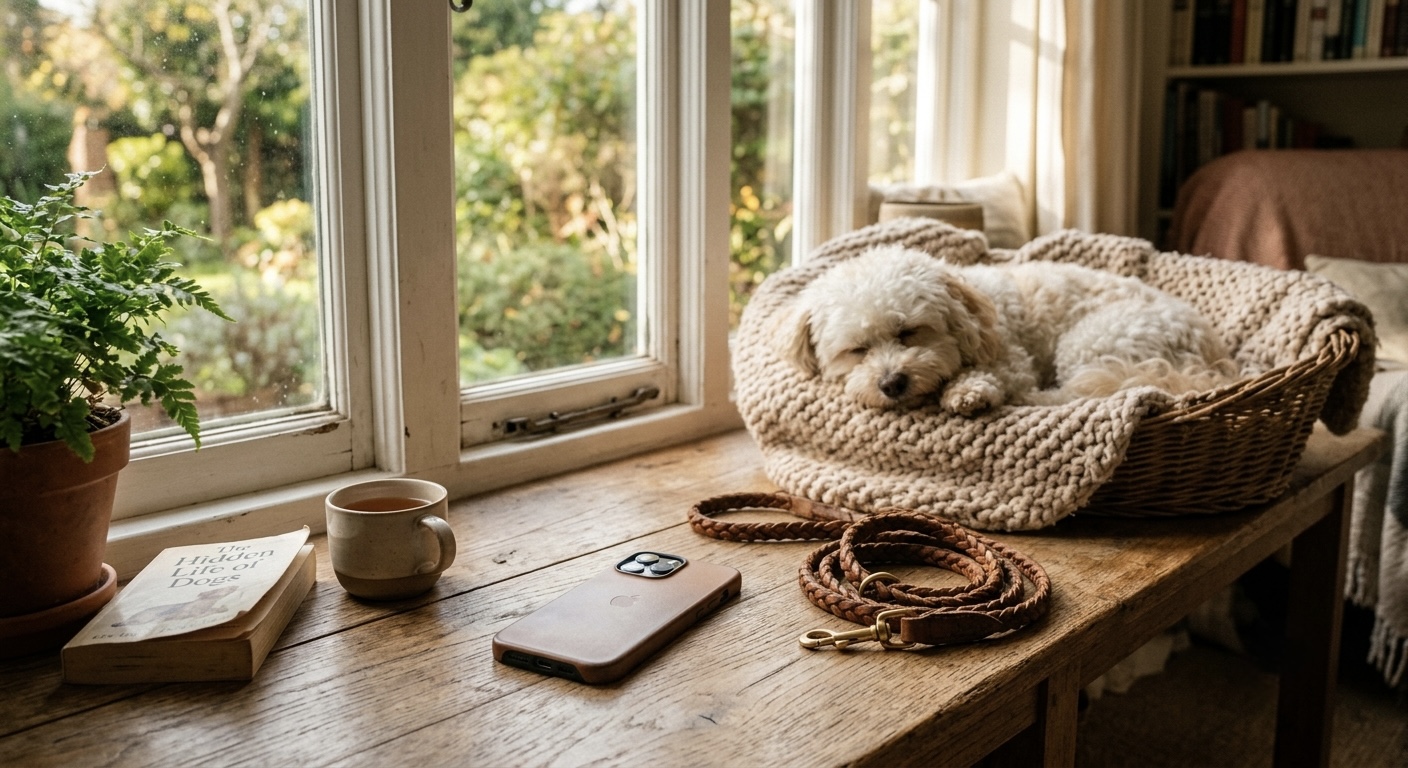
Which brings me back to the walks. Sophie is a Shih Tzu with strong opinions and short legs. Luna is a Mini Goldendoodle who thinks every squirrel is a personal invitation. Twice a day, rain or July heat, we go out, and the deal I have made with myself this summer is simple: the phone stays in my pocket for the loop. Not off, not gray, just away.
It is a small thing and it has done more for me than any launcher ever did. Fifteen minutes of watching two dogs be delighted by an ordinary sidewalk is a decent reset for a brain that spent all day in spreadsheets and Xcode. The grass really is right there. You do not need a different phone to go look at it. You just need to decide the walk is not a thing to get through so you can get back to the screen.
What I am actually doing about it
No grand system. I moved the apps that have feeds off my home screen so opening one is a choice and not a reflex. I set the phone face down at dinner. I do the walk with nothing in my hands. And on the building side, I keep asking the one question that matters when you make things people carry everywhere: does this respect the person's time, or does it quietly depend on wasting it. If the honest answer is the second one, it does not ship.
That is the whole essay, really. The phone is not the enemy and neither is grayscale. The thing worth protecting is your attention, and the good news is you get to decide where it goes a hundred small times a day. This summer I am mostly deciding on the dogs.
For the values behind the apps, see What on-device AI means, and you can see what this studio actually builds at jcmobileappstudio.com.
Comments
Be kind and stay on topic. Comments are reviewed before they appear.