I had a tab open on a refurbished iPhone 15 Plus going for about $400 next to a new big iPhone at about $900, and the gap, roughly $500, is what got me thinking. Five hundred dollars is not life-changing on its own. But a phone is not a one-time decision, it is a thing you replace every few years for the rest of your life. So the right question is not "can I save $500 once," it is "what is that habit worth over a couple of decades."
The one-time version
Say you save $500 once by buying refurbished instead of new, and you put it in a broad, low-cost index fund and forget about it. Using a 7 percent average annual return, which is a common long-run stock-market assumption and absolutely not a promise, that $500 becomes roughly:
- about $980 in 10 years
- about $1,935 in 20 years
- about $3,800 in 30 years
So the real price of buying new is not the $500 sticker gap. It is the $3,800 that same $500 could have become if you had let it compound for 30 years. That is the part the sticker never shows you.
The version that actually matters: doing it every time
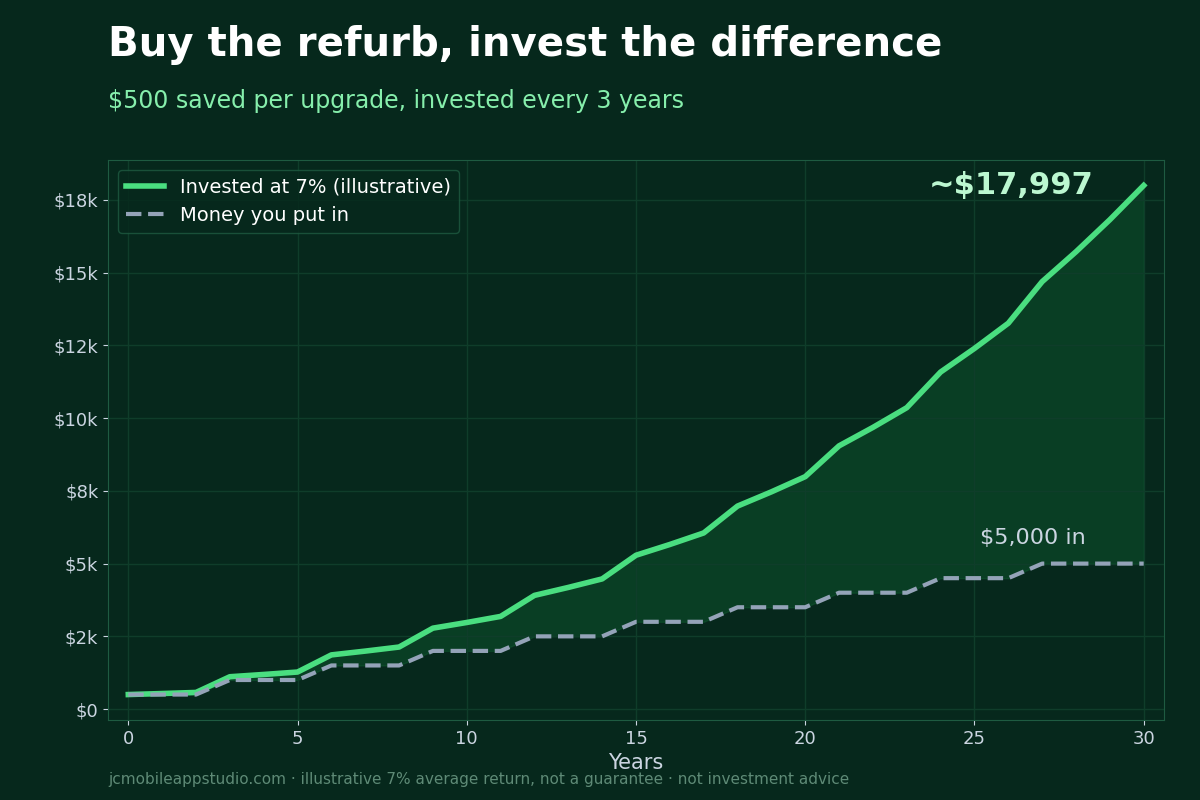
Here is where it gets interesting. Most of us replace a phone roughly every three years. If you save $500 each cycle and invest it every time, then over 30 years you will have put in $5,000 of your own money, ten upgrades worth, and at that same 7 percent it grows to roughly $18,000. The phones cost you the same either way. The difference is that one path quietly builds an $18,000 pile and the other does not.
And the bigger the gap, the louder the math. The Pixel Fold on sale this week is $1,350 below its original price. Invest a one-time $1,350 at 7 percent and in 30 years it is worth a little over $10,000. One folding-phone decision, ten grand of difference, if you have the discipline to actually invest the gap rather than spend it.
The honest caveats
I have to be square with you about what this is and is not. The 7 percent is an illustration, a rough long-run average, not a number you are owed. Real returns are lumpy: some years are up 25 percent, some are down 20, and a string of bad years early on hurts more than the average suggests. I have ignored inflation, which eats into these figures over decades, and I have ignored taxes, though a retirement account or a buy-and-hold index fund keeps those low. The math is meant to show the shape of the idea, not to predict your balance.
There is also a behavioral catch, and it is the whole game. "Invest the difference" only works if you actually invest the difference. If the $500 you saved just becomes $500 of other spending, you got a cheaper phone and nothing else. The trick that makes it real is automation: move the saved amount into your brokerage the same day you buy the phone, before it evaporates into the budget.
The takeaway
None of this means you should never buy a new phone. A current model with a long software runway can be the better buy, and sometimes the thing you want is worth paying for. The point is smaller and more useful than "always buy cheap." It is that the gap between new and refurbished is not free money you saved, it is a deposit you chose not to make. Once you see a phone upgrade as a recurring line item for the rest of your life, buying one tier down and investing the difference stops looking like being cheap and starts looking like a plan.
If you want to see the actual deals that started this whole train of thought, the ranked roundup is here: the Woot phone and watch sale, ranked. This post is general information for thinking through a tradeoff, not personalized investment advice, your situation, timeline, and risk tolerance are yours.
Comments
Be kind and stay on topic. Comments are reviewed before they appear.