
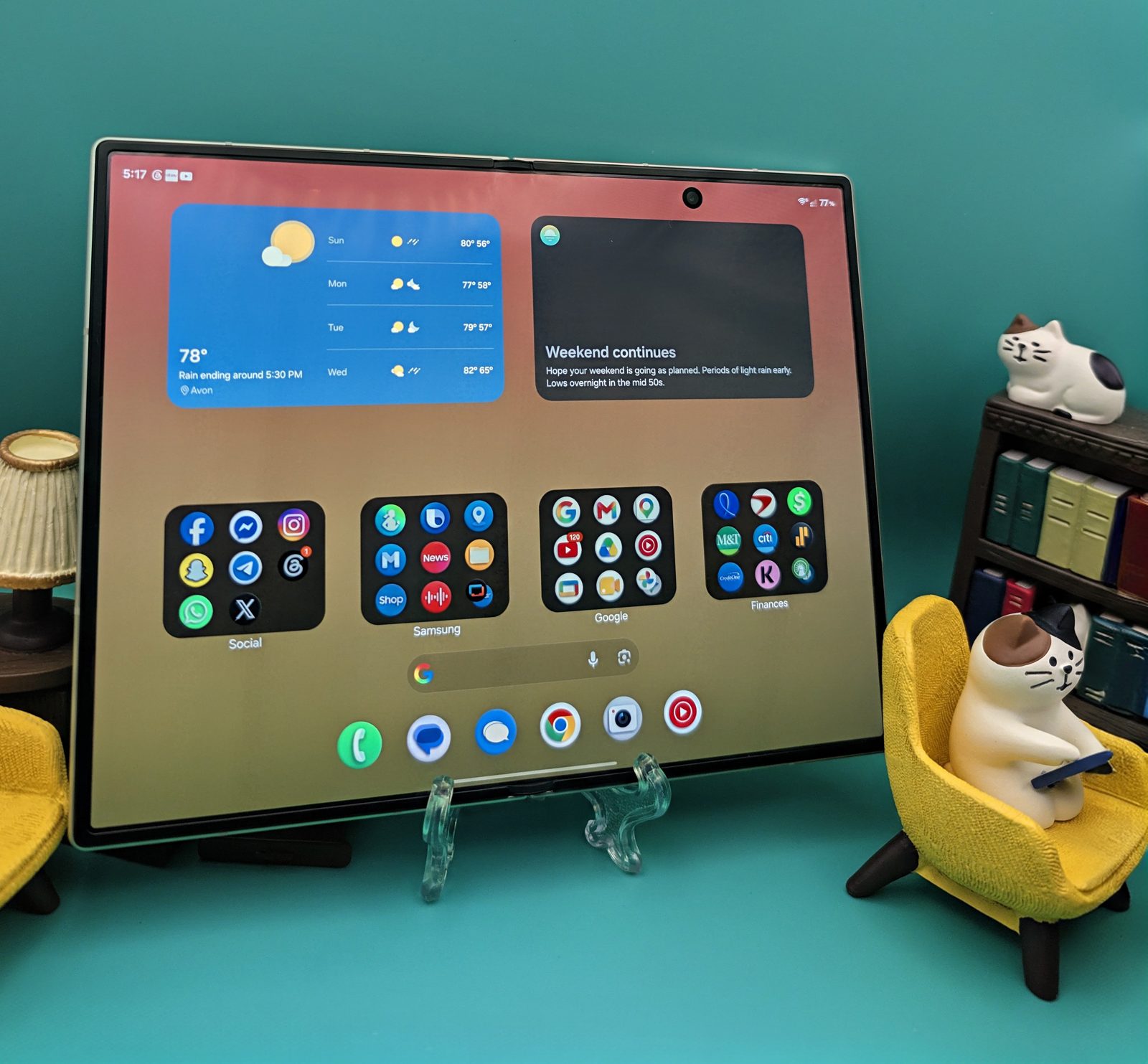
Full disclosure. I have a Galaxy Z Fold 8 in white, it has been my personal daily driver since early August, and I like it more than I expected to. So when I tell you Samsung is having its best foldable year ever, understand that I am one of the data points.
I think one of these two stories is Samsung at its best and the other is Samsung at its most insecure, and the gap between them is the whole argument.
Five foldables, and the reason behind it
Per ETNews, relayed through Ice Universe and picked up by Notebookcheck, Samsung is preparing five foldables for 2027. A wide Galaxy Z Fold9. A second wide screen Fold9 variant, likely at a different price tier. A Z Fold9 Ultra with a taller screen. A Z TriFold2. And the Z Flip9.
The wider leak, covered by 9to5Google, puts it in context as a four plus four year, four S27 models including a new S27 Pro slotting under the Ultra, and four foldables. Eight flagships.
The reason for two wide Folds is the part I care about. The wide aspect Z Fold 8 that launched in July 2026 sold well, and Samsung's response is not to protect it, it is to build a second one at a different price. That is a company reading its own sales data and moving, fast, with conviction. The Z Fold 8 starts at $1,899.99, so a cheaper wide Fold would be the first time the good foldable shape is available to someone who is not already committed.
The TriFold detail is even more interesting. The first TriFold was pulled after about three months and a limited release, and Samsung is going back to it anyway with a refined design. Most companies bury that. Samsung is treating a commercial failure as a version one. Whatever you think of Samsung's software, that is real hardware ambition and no other phone maker on earth is currently doing it.
Then the S27 Ultra leak showed up
Ice Universe published CAD based imagery of the Galaxy S27 Ultra, covered by SamMobile. A thick rectangular camera bar across the top with three sensors, two of them ringed individually, a pill shaped module holding the third camera plus laser autofocus and flash, and a built in circular magnet ring for Qi2. SamMobile's own line is that the layout, and the camera island in particular, "looks a lot like the iPhone 17 Pro."
Rumored cameras are a 200MP main with OIS, a 50MP ultrawide with autofocus, and a 50MP 5x telephoto. Those are genuinely Samsung specs. The body around them is not.
Here is my opinion and I am not going to soften it. Samsung does not have to do this.
Samsung has its own ecosystem, its own design language, its own manufacturing advantages, and in the one category where it is unambiguously ahead of Apple it is ahead because it did the opposite of following. Nobody bought a Z Fold 8 because it reminded them of an iPhone. The camera bar is a genuinely Samsung idea, it goes back through the Note line, it is recognizable across a room, and trading it for a rectangle that reads as somebody else's rectangle is the kind of decision that wins a quarter and loses a decade of identity.
I want to be fair about two things. First, this is a CAD leak from a tipster, not a product, and CAD leaks have been wrong about final finishes and module shapes before. Second, some convergence is not copying, it is physics and standards. That circular magnet ring is Qi2, which is an open standard everyone is adopting, and a big sensor stack in the top corner is where a big sensor stack goes. Not every similarity is theft.
The camera island is not that. That is a styling choice, and Samsung chose to look like the other guy.
What this says about Google, and the shape it walked away from
Now the part almost nobody connects.
The wide, passport shaped foldable that Samsung just had a hit with, and that Apple is reportedly launching in a book style shape next month? Google shipped that first. The original Pixel Fold had a 5.8 inch outer display that was significantly wider than what the competition was doing, and a 7.6 inch inner screen that felt bigger in practice than the number suggested because both apps in split screen got a sane orientation. Android Police made this exact case, arguing that current tall folds are "awkward compromises" where neither screen is optimized, and that each app in a wide fold gets "the proper orientation, nothing feels cramped" (Android Police).
Google had it. Google left it. And then it watched Samsung sell a wide Fold well enough to double down on wide for 2027, and it is watching Apple reportedly ship a first foldable in a shape closer to that idea than to the tall folds Google switched to.
The Pixel 11 Pro Fold, announced August 12, is a legitimately better piece of hardware than the last one, a stronger hinge, 1mm thinner, about 20 grams lighter, displays 20 percent brighter with 3,600 nits peak, a 48MP main, and a $1,899 price, though the battery dropped to 4,750mAh from 5,015mAh (TechCrunch). It is a good phone. It is also, structurally, a follower's phone, in a shape Google adopted after abandoning its own better idea.
If Google went back to the passport, the story writes itself and it is a good one, we were right the first time. The risk is that going back now reads as chasing Samsung, which is the exact trap Samsung just walked into with the S27 camera bar. The window where Google could have owned that shape as its own is closing, and Google is the one who opened it.
What it means for Apple
Apple's problem is the opposite and it is the better problem. Reported specs put the foldable at roughly 5.5 inches outside and 7.8 inches open, about 4.5mm unfolded, Touch ID in the side button because there is no depth for Face ID, and only two cameras with no telephoto at a reported two thousand dollar starting price (MacRumors).
I think Apple ships this one, sells every unit it can build to people who were always going to buy it, and then spends two or three years quietly fixing it rather than fanning out into a lineup. Gurman has reported third generation foldables with larger displays already in development for a possible 2028 launch, which reads to me as a slow ladder, not a portfolio. Apple does not do four shapes. Apple does one shape for a long time and then a second one when the first is boring.
Samsung will have five foldables in 2027. Apple will probably have one, maybe two. Those are not the same strategy and neither is wrong. Samsung's advantage is that it will learn five times faster. Apple's advantage is that it will only have to support one hinge for years, and every developer including me will target it without hedging.
The fan blog framing where Apple arrives and shows Samsung how folding is done deserves pushback before it starts. Samsung has been iterating hinges since 2019 and eating the failures in public. Apple is arriving in year eight of someone else's research with a thinner body and no zoom.
Why this matters here
I build on-device apps for iPhone and iPad, so the shape Apple picks is the shape I have to design for, and 7.8 inches open in a book layout is closer to a small iPad than to a big phone. That means the honest work is reflow, not stretch, and it is the same lesson the iPad taught everyone a decade ago. My Fold 8 is Android so I do not test my own apps on it, it is my daily driver and my review subject, but it has been an unbelievably useful education in what a big inner screen actually feels like in a pocket for a month. What I actually ship lives at jcmobileappstudio.com/apps.
The caveats, once. The 2027 lineup is a supply chain leak via ETNews and Ice Universe, not an announcement, and lineup plans change more often than any other category of leak. The S27 Ultra imagery is CAD based and could differ from the shipping product. Apple's foldable specs are Gurman's reporting, not confirmed specs, and the price is an expectation. Verified August 24, 2026.
Comments
Be kind and stay on topic. Comments are reviewed before they appear.