What the court decided
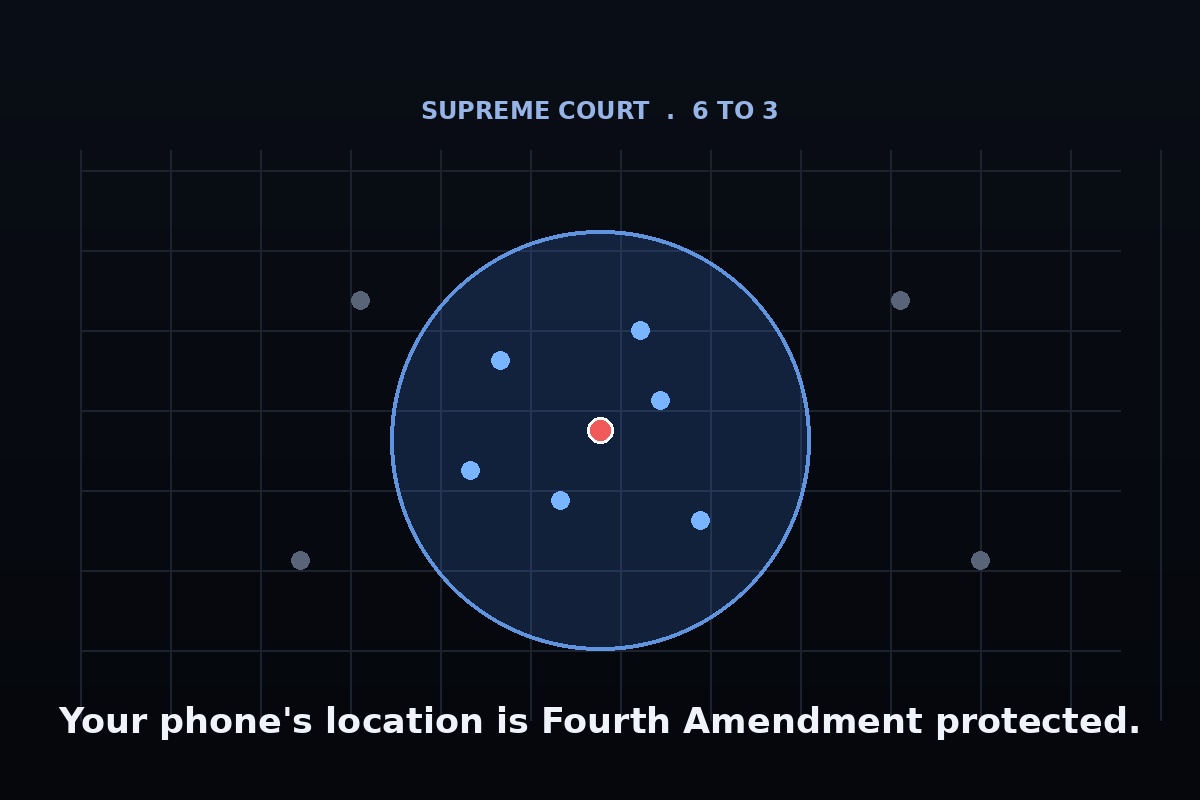
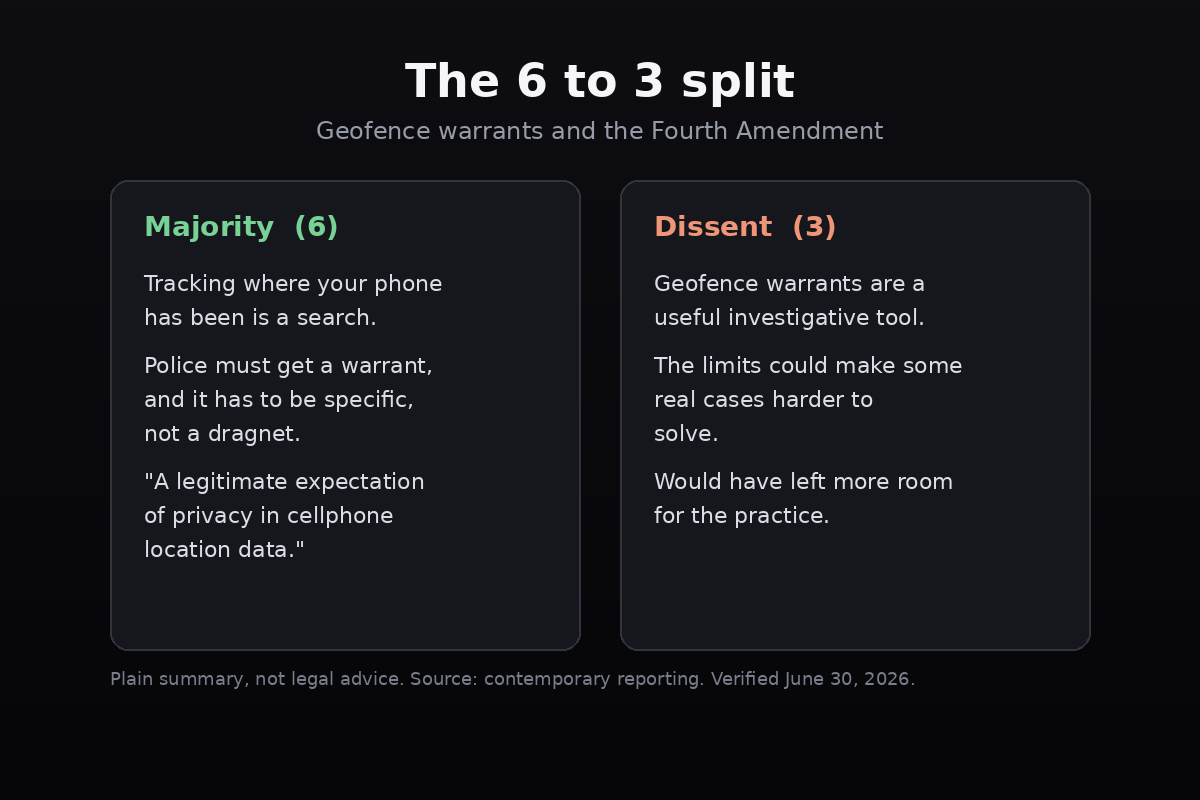
The justices held that using a geofence warrant to capture cellphone location data is a search for Fourth Amendment purposes, which means police generally have to get a warrant, and that warrant has to be particularized, specific enough that it is not just a fishing expedition. The court put it plainly: "An individual has a legitimate expectation of privacy in his cellphone location data." Justice Elena Kagan wrote for a cross-ideological majority, and the court split 6 to 3, with three of the conservative justices dissenting. (CNN)
The case behind it
It started with a 2019 bank robbery in Virginia. After the investigation went cold, police served Google with a geofence warrant to identify a handful of people whose phones placed them within about 300 meters of the bank at the time. That pulled in a man named Okello Chatrie, who was charged and then challenged the method all the way up. The court agreed the technique crossed a constitutional line, though it did not rule on the specific Virginia warrant itself.
What a geofence warrant actually is
A normal warrant names a suspect and asks for evidence about that person. A geofence warrant flips it around. Instead of starting with a suspect, it starts with a place and a time, draws a circle on the map, and asks a company like Google for every device that was inside that circle. The problem is obvious once you picture it: that circle does not only catch the guilty person. It catches the neighbor walking a dog, the nurse driving to work, anyone who happened to be nearby. A reverse search that begins with innocent people and works backward is exactly the kind of dragnet the Fourth Amendment was written to check.
This ruling extends a line the court started in 2018 in Carpenter v. United States, which held that police need a warrant for historical cell-site records. The throughline is simple: the data your phone constantly sheds about where you go is sensitive enough to deserve real protection.
The case the other side made
It is worth taking the dissent seriously, because this is not a simple good-versus-evil story. The dissenting justices and many in law enforcement see geofence warrants as a legitimate, court-supervised tool that has helped solve serious crimes, from robberies to worse, when investigators had little else to go on. Their worry is that a strict rule could make some genuinely hard cases harder to crack, and that the better answer is careful limits on how these warrants are written, not treating every one of them as suspect. If you have ever wanted police to catch a violent offender, that argument deserves a fair hearing.
Where do you land?
Full disclosure, I build privacy-first apps, so my instinct leans toward protecting this data. But reasonable people land in different places here, and the trade-off between privacy and public safety is real, not imaginary. So I am genuinely curious where you come down.
Do you agree with the Supreme Court's ruling?
Tap an answer to vote and see how readers are split.
This is a plain-language summary to help you follow the news, not legal advice, and the poll is an informal, unscientific reader gut-check, not a real survey. For more on protecting your own data, see encryption explained. You can see what this privacy-first studio builds at jcmobileappstudio.com.
Comments
Be kind and stay on topic. Comments are reviewed before they appear.