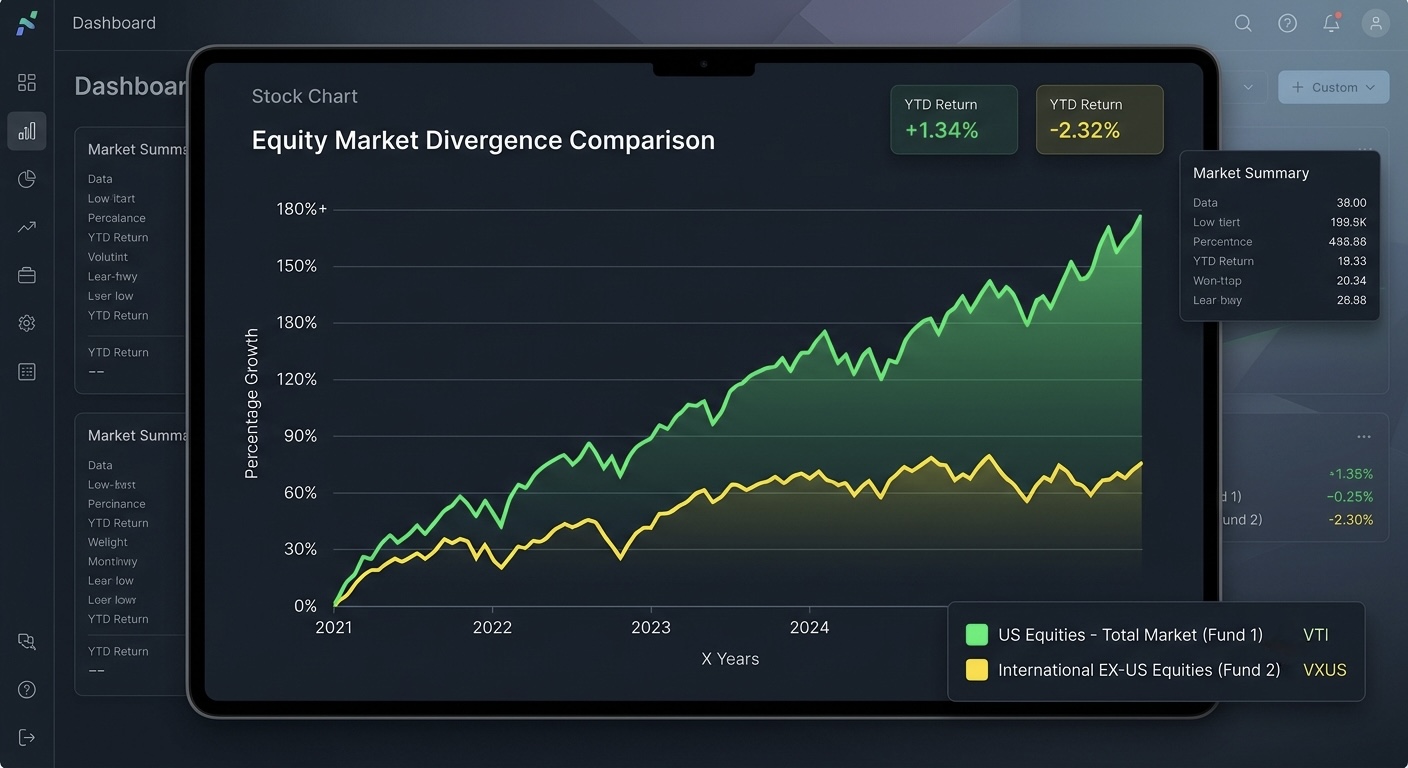
Quick numbers first, because the numbers are the story. Through Friday, July 17, with dividends reinvested, VTI (Vanguard's total US stock market fund) is up 10.13% year to date. VXUS (total international) is up 11.12%. BND, the total bond fund, is up 0.33%. That's per totalrealreturns.com.
Read that again if you need to. International is beating the US this year. Not by a mile, but it's ahead, and earlier in the year the gap was much wider. Through roughly the first four months of 2026, VXUS was up about 10% while VTI was up about 6%, per a Forbes piece updated July 8. The US market has closed most of that gap since, but it's still chasing.
I hold all three of these funds at Fidelity, so this isn't an abstract exercise for me. And I'd bet most people holding VTI have no idea this is happening, because the default assumption for a decade has been that US stocks win and international is the drag you tolerate for diversification.
Why International Is Winning
A few real things are going on, none of them exotic. Changing US trade policy has investors rethinking how much of their money should sit in one country's market. Europe is spending heavily on defense, which flows straight into European company earnings, and the broader European economy has been improving. And there's the dollar: when the dollar weakens, the same foreign stocks are worth more in dollar terms, so VXUS gets a tailwind. VTI tends to benefit when the dollar acts as a safe haven instead. This year, the currency math has mostly favored international.
None of that erases the last twenty years. US mega-cap tech has dominated for two decades, and that dominance is why everyone's portfolio drifted American in the first place. But this year, international is closing the gap, and pretending otherwise because it doesn't match the story in your head is exactly the mistake index investing is supposed to protect you from.
The Valuation Gap Is the Part Worth Staring At
Here's the number I keep coming back to. Per Forbes, VXUS trades at a price-to-earnings ratio of about 17.5. VTI trades at about 26.7.
In plain language: for every dollar of company earnings, you're paying about $17.50 to own it through VXUS and about $26.70 to own it through VTI. US stocks cost roughly 50% more per dollar of earnings than international stocks. Sometimes paying up is justified, US companies have grown earnings faster for years. But a gap that wide means the US market is priced for that outperformance to continue more or less forever, and international is priced for not much at all. When expectations are that lopsided, the cheaper side doesn't need great news to do well. It just needs less-bad news. That's a decent description of 2026 so far.
Costs, for the record, are a wash. VTI's expense ratio is 0.03%, VXUS is 0.05%. Both are effectively free. This has never been a reason to skip international.
What I'm Actually Doing About It
Nothing dramatic, and that's the point. I'm not selling VTI to chase VXUS, I don't trade headlines, and I'm not predicting international keeps winning. Six months of returns is weather, not climate.
But there is one boring, useful thing to do: check your drift. If you set a target like 70/30 or 60/40 US to international a few years ago, years of US outperformance have almost certainly pulled your actual split above target. Somebody who started at 70/30 might be sitting at 78/22 without ever making a decision. Rebalancing means trimming what ran and buying what lagged, and here's the uncomfortable part: for years that meant trimming US winners to buy international laggards, and it felt like throwing good money after bad. This year the same discipline points the other way from habit. The mechanics didn't change. Your feelings about them did.
The other lesson is about timing, or rather, about how bad we all are at it. The "why bother with international, just buy VTI and chill" argument was everywhere over the past couple of years, right at peak US outperformance. That argument always shows up loudest right before international has a year like this one. Not because anyone can predict the turn, but because the argument only feels obvious after one side has already run. If you dumped your international allocation in 2024 or 2025 because it "never works," 2026 is the market's polite reminder of why you held it.
So: pull up your accounts, add up US versus international, compare it to whatever target you actually chose on purpose, and fix the gap if it's meaningful. That's the whole move. This is a recap of what happened, not investment advice.
This is a general recap, not investment advice. Your own situation, risk tolerance, and time horizon always come first.
Comments
Be kind and stay on topic. Comments are reviewed before they appear.