Start with the word, because it is doing a lot of work. A chatbot answers a question. An agent is given a goal and the ability to take steps toward it on its own, calling tools, reading data, and chaining actions together until the task is done. Booking the trip instead of telling you how to book it. That is the whole shift in one sentence, from a thing you talk to into a thing that does things for you.
Why 2026 is the year it tipped
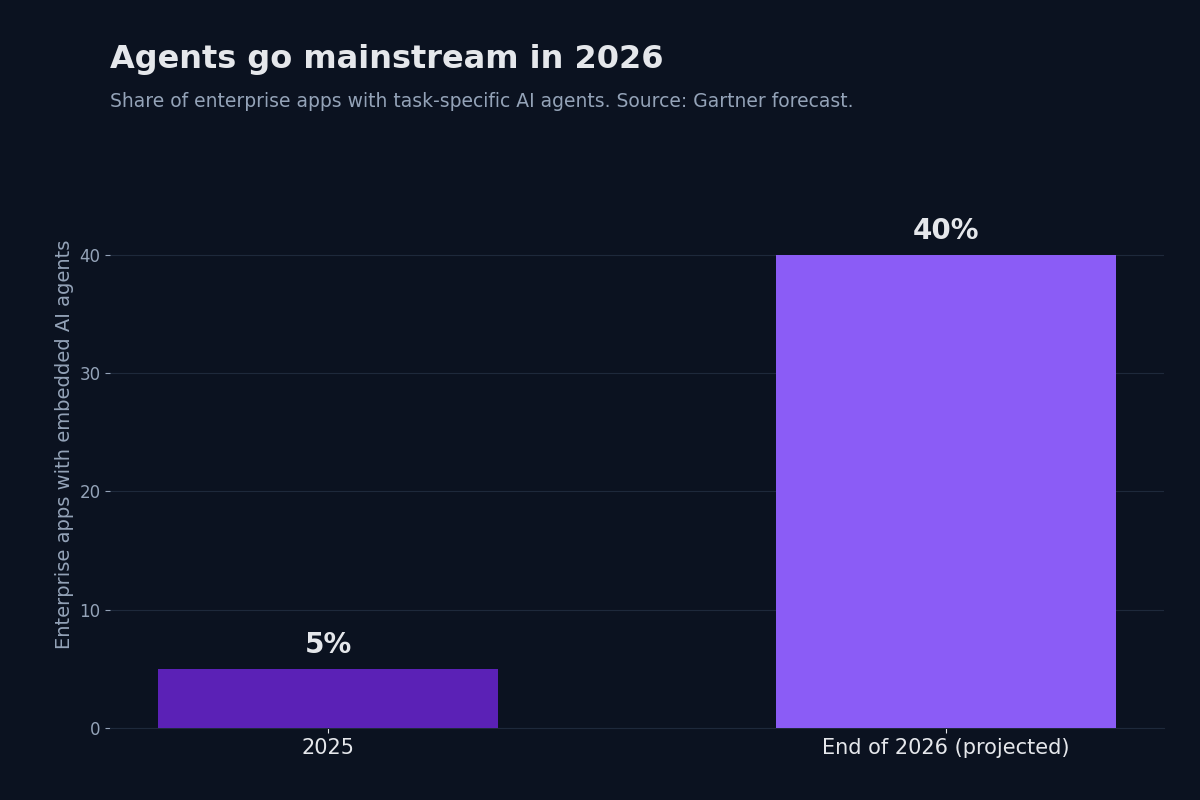
The adoption curve got steep. Gartner forecasts that about 40 percent of enterprise applications will have task-specific AI agents built in by the end of 2026, up from under 5 percent in 2025. Google Cloud and other analysts describe the same crossing, agents moving from pilots and demos into actual production systems this year. The common use cases are not glamorous, customer service, finance and operations, security and compliance, sales, and HR, which is exactly how you know it is becoming real instead of a keynote trick. (Gartner)
The part the headlines skip
Here is the honest counterweight, and it sits inside the same optimistic reports. Gartner also expects more than 40 percent of agentic AI projects to be canceled by 2027, undone by unclear value, rising costs, and weak guardrails. Surveys put real, measured ROI well below the breathless projections. So both things are true at once, agents are genuinely going mainstream, and a large slice of the projects chasing them will not survive contact with reality. Mainstream does not mean magic.
What an agent needs to actually work
The projects that succeed tend to share a few boring traits. A narrow, well-defined job rather than do anything. Clean data the agent is allowed to reach. Clear limits on what it can do without a human signing off. And a way to check its work, because an agent that acts confidently and wrongly is worse than a chatbot that just gives a bad answer. The failures usually come from skipping those, pointing a powerful, eager system at a vague goal and messy data and hoping.
What this means for a regular person
You will meet agents whether or not you went looking. They are being stitched into the apps you already use, your email, your bank, your phone's assistant, the help desk you chat with. Two habits are worth keeping. First, know when you are handing a decision to software that can act, and keep the consequential ones, money, contracts, anything hard to undo, behind your own confirmation. Second, judge these tools by whether they actually save you time, not by how impressive the demo looked. The useful ones quietly remove a chore. The rest are a feature someone wanted to announce.
The bottom line
2026 is a real inflection point, agents moved from slideware to shipping software, and that is worth paying attention to. It is also a year where the gap between a working agent and an expensive disappointment is wide, and the reports cheering the adoption are the same ones predicting the cancellations. Treat the technology as promising and unfinished, useful when it is aimed at a narrow job with a human in the loop, and oversold everywhere else.
For the longer arc behind this, see from chatbots to coworkers, and for the privacy angle on AI that runs without the cloud, what on-device AI means. You can see what this studio builds at jcmobileappstudio.com.
Comments
Be kind and stay on topic. Comments are reviewed before they appear.