I write this as someone who handles HR for a living, not as a lawyer, so treat this as a plain map of how heat works at work, then check your state and your own workplace for the specifics. The short version: heat is a recognized safety hazard, the rules are a patchwork, and a few simple things, water, rest, shade, separate the safe job sites from the dangerous ones.
Is there a heat law?
There is no final, nationwide OSHA heat standard, at least not yet. OSHA published a proposed federal heat rule in August 2024, but as of mid-2026 it is still just that, proposed, and it has stalled with no firm date to become final. (OSHA) That does not mean heat is unregulated. Two things still protect you. First, the General Duty Clause, which requires employers to keep a workplace "free from recognized hazards," and OSHA does cite employers for heat under it. Second, OSHA runs a National Emphasis Program for heat, updated in April 2026 and set to run for years, which means inspectors are actively looking at heat exposure on the job.
Several states go further with their own rules. California, Oregon, Washington, Nevada, Colorado, Minnesota, and Maryland have adopted heat protections of their own, often requiring water, shade, and rest above a set temperature. If you work in one of those states, your local rule is usually the stronger one to know.
What good heat protection looks like
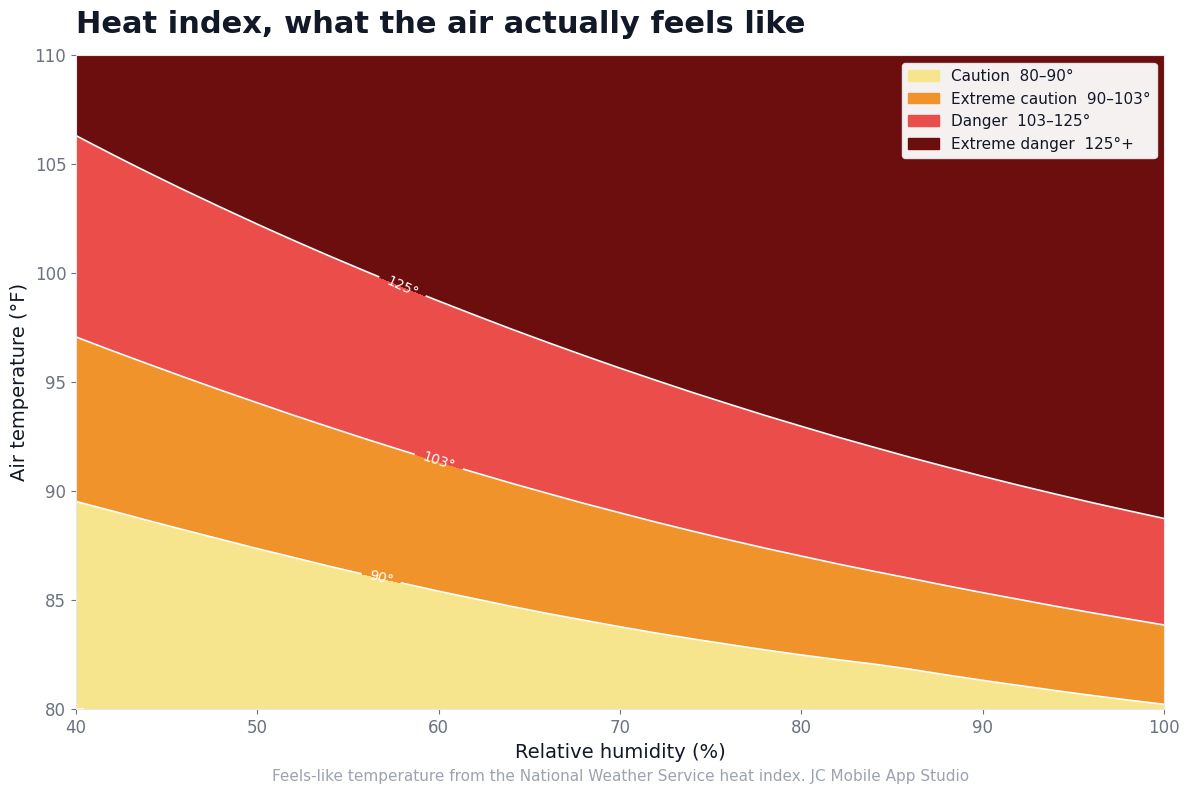
The proposed federal rule is a useful template even though it is not final, because it captures what safety professionals already consider best practice. Its first trigger is a heat index of 80°F sustained for more than 15 minutes in an hour, and notice that is the heat index, the feels-like number that combines temperature and humidity, not the plain thermometer reading. On a humid day, 88°F air can feel like 100°F or worse, which is the whole point of the chart above.
At a heat-index trigger, reasonable protection includes:
- Cool drinking water, easy to reach, enough for about one cup every 20 minutes.
- Shade or a cool area for breaks, and paid rest breaks when it is hot enough.
- Acclimatization, easing new workers and anyone returning from time off into the heat over a week or so, because most serious heat illness hits people in their first days on a hot job.
- A heat plan and training, so everyone knows the warning signs and what to do.
Sponsored
Know the difference: exhaustion versus stroke
This is the part worth memorizing, because the two look similar and the response is different. Heat exhaustion shows up as heavy sweating, cold or clammy skin, dizziness, headache, nausea, and weakness. Move the person to a cool place, give water, loosen clothing, and cool them down. Heat stroke is the emergency, the body's cooling has failed. The signs flip: skin may be hot and dry or still sweaty, body temperature is very high, and crucially there is confusion, slurred speech, or loss of consciousness. Heat stroke is a call-911 situation. While help is on the way, move the person to shade and cool them aggressively with water or ice. When in doubt, treat confusion in the heat as a medical emergency.
What you can ask for, and do
You can ask your employer for water, shade, and rest breaks when it is dangerously hot, and for the workplace's heat plan if there is one. You can report unsafe heat conditions to OSHA, and it is illegal for your employer to retaliate against you for raising a safety concern in good faith. If you are in a state with its own heat rule, you can point to that rule by name. And on a personal level, hydrate before you are thirsty, watch your coworkers as much as yourself, and speak up early, heat illness escalates fast once it starts.
The bottom line
The federal rulebook on heat is still being written, but your right to a workplace free of recognized hazards is not new, and the things that actually prevent heat illness are cheap and simple. Know the feels-like number, not just the temperature. Know the difference between exhaustion and stroke. And remember that asking for water and shade on a brutal day is not being difficult, it is asking for the bare minimum that keeps people alive. General information, not legal advice, check your state and a qualified professional for your situation.
Plantilla, the studio's workers' rights companion, puts plain-language rights guidance in ten languages on your phone. You can see it and the rest of what this studio builds at jcmobileappstudio.com.
— JC Mobile App Studio