Usual disclaimer first, and it is not boilerplate. This is a recap of a single trading day, written so the headlines make sense, not a prediction and not a recommendation to buy or sell anything. The figures are accurate as of Thursday, July 2, 2026, and they will drift the moment markets reopen. The point is the story, not the ticker.
How the day closed
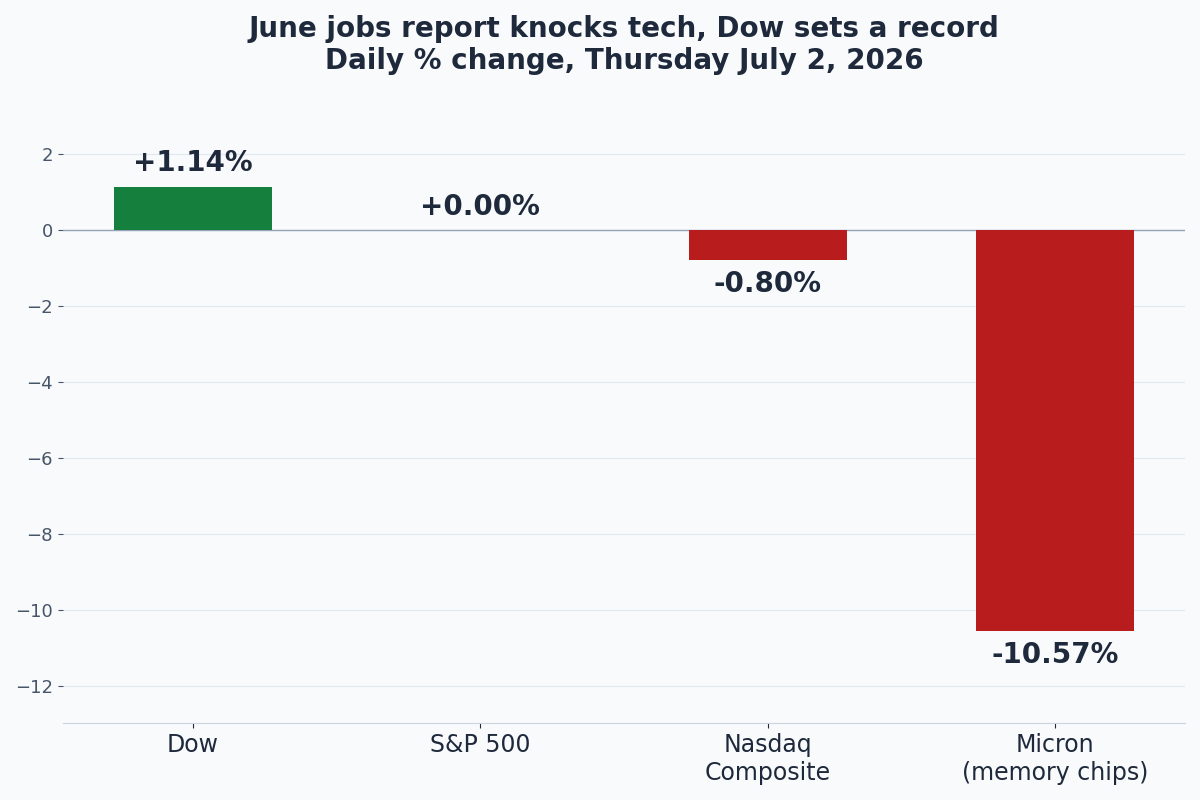
The Dow Jones Industrial Average rose about 1.14 percent to close at 52,900.07, another record high. The S&P 500 finished essentially flat, as declines in technology stocks offset gains in most of the other sectors. The Nasdaq Composite fell about 0.8 percent, and the more tech heavy Nasdaq 100 was down as much as 1.6 percent intraday. When the Dow rises on the same day the Nasdaq falls, that usually means the rally is concentrated outside of big tech, which is exactly what happened here. (Yahoo Finance)
The jobs report that moved everything
The Labor Department reported the U.S. economy added just 57,000 jobs in June, well below the roughly 115,000 economists expected and down from a downwardly revised 129,000 in May. The unemployment rate actually dipped to 4.2 percent, but for a reason that is not encouraging on its own, the labor force participation rate fell to 61.5 percent, its lowest level since March 2021, meaning fewer people were counted as looking for work at all. Average hourly earnings rose 3.5 percent from a year ago, which still trails the most recent inflation reading of 4.2 percent, so real wage growth stayed negative. (CNBC)
A soft jobs report can cut two ways for stocks. It can worry investors about a slowing economy, or it can be read as a reason for the Federal Reserve to eventually ease up on rates. Thursday looked like a bit of both, broad market strength alongside real selling pressure in the sectors most sensitive to growth and rate expectations, chips and AI names.
Memory chips led the selling
The rout started overseas. South Korea's Kospi index fell 7.9 percent as memory chipmakers got hit hard, with SK Hynix down more than 14 percent and Samsung Electronics down over 9 percent. That weakness carried into the U.S. session, where Micron Technology, the largest American memory chip maker, fell more than 10 percent. It is a sharp reminder that the same memory shortage that has been pushing up prices on phones, laptops, and tablets all year is also whipsawing the stocks of the companies that make the chips. (Yahoo Finance)
Markets are closed Friday
U.S. markets are closed Friday, July 3, 2026, in observance of Independence Day, so Thursday's close is the one that stands until Monday. Fed Chairman Kevin Warsh also commented Wednesday that inflation risks "have come down" as energy prices eased following progress in U.S. Iran talks, though he noted prices are still a bit above pre conflict levels.
For the bigger picture on where markets stood heading into the back half of the year, see the first half 2026 recap, and for a plain explainer on this same memory chip squeeze, why Apple raised prices on Macs and iPads. You can see what this studio builds at jcmobileappstudio.com.
Comments
Be kind and stay on topic. Comments are reviewed before they appear.