Usual disclaimer first, and it is not boilerplate. This is a recap of a single trading day, written so the headlines make sense, not a prediction and not a recommendation to buy or sell anything. The figures are accurate as of the close on Tuesday, June 16, 2026, and they will drift the moment markets open again. That is normal. The point here is the story behind the numbers, not the numbers themselves.
The close: a record Dow, a soft Nasdaq
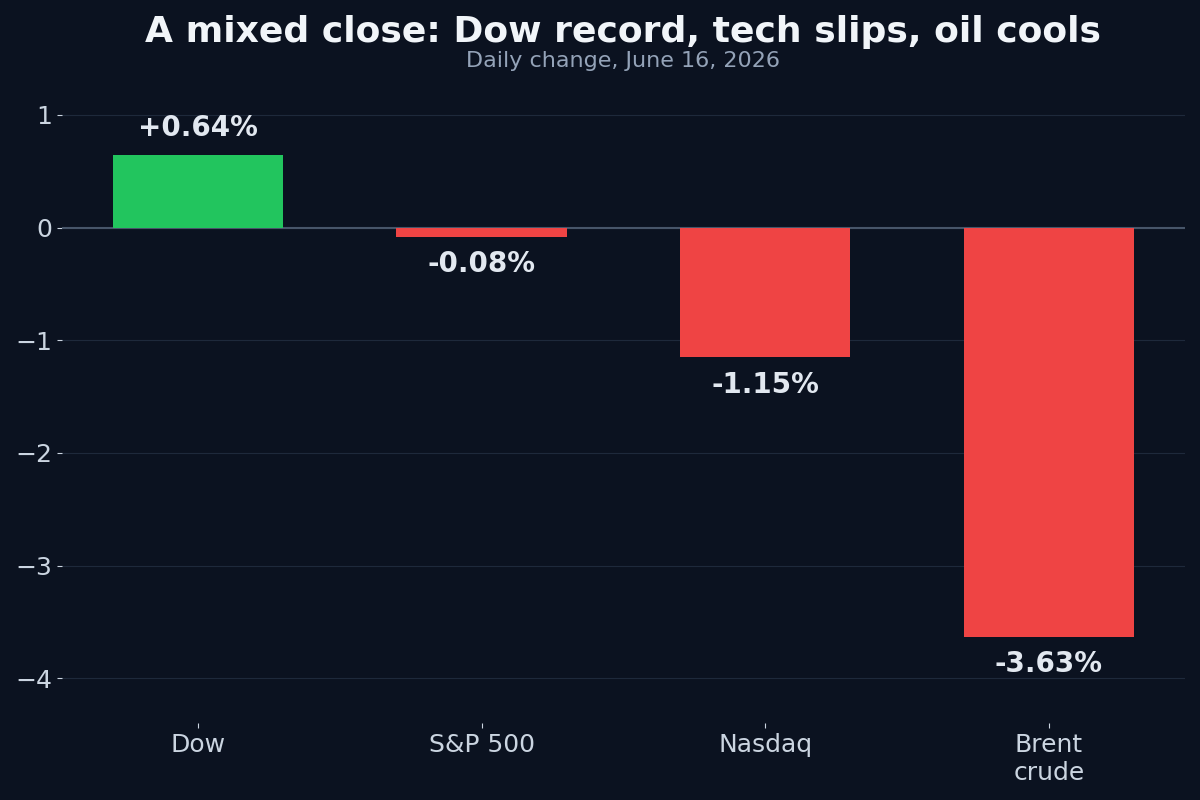
The Dow rose about 0.64 percent, roughly 329 points, to close just shy of 52,000, a fresh record high. The S&P 500 barely moved, slipping about 0.08 percent to 7,548.60. The Nasdaq Composite fell about 1.15 percent to 26,376.34, dragged lower by technology stocks. So the same trading session produced a record for one index and a clear down day for another. If you only saw a headline that said "stocks fall," you would have missed half the story, and if you only saw "Dow hits record," you would have missed the other half. (TheStreet)
Oil cooled, and energy stocks felt it
The other big mover was crude. Brent traded around 81.55 dollars a barrel, down about 3 dollars, roughly 3.6 percent on the day. That is still about 9 dollars higher than a year ago, so this is a cooling, not a collapse, but a 3.6 percent drop in a single session is enough to pull energy stocks down with it. Lower oil tends to be good news for inflation and for consumers at the pump, and a headwind for the energy sector's share prices on the day it happens. Both things can be true at once. (Fortune)
The backdrop: a shaky ceasefire and a rate hike abroad
None of this happened in a vacuum. Investors were weighing an uncertain ceasefire between the United States and Iran, with a formal signing aimed for Friday, and a fresh rate hike from the Bank of Japan. Inflation has climbed to its highest in three years, pushed up partly by higher energy prices tied to the Middle East conflict. That mix, a fragile peace, tighter policy overseas, and stubborn inflation at home, is exactly the kind of cloudy setup where money gets cautious and selective rather than uniformly bullish or bearish. (Yahoo Finance)
Why a "mixed" tape happens at all
Here is the part worth slowing down on, because it explains the whole day. The Dow and the Nasdaq are not two thermometers reading the same room. They are two different baskets of stocks. The Dow is heavy on value names and industrials, steadier companies whose earnings do not swing wildly with interest rates. The Nasdaq is heavy on rate-sensitive growth and technology, companies whose value leans on profits expected years from now, which is exactly what higher rates discount the most.
So on a day when the big looming event is a Fed decision and there is real talk of rates staying high or even rising, money can quietly rotate out of expensive tech and into steadier names. That single move lifts the Dow while it drags the Nasdaq down. Same news, different baskets, opposite-looking results. It is not a contradiction, it is just the market sorting which kinds of companies it wants to own when the cost of money looks like it might stay elevated.
The big event sits on Wednesday: the Fed under Warsh
All of Tuesday's caution points at one date. Wednesday, June 17 brings the Federal Reserve's first rate decision under its new chair, Kevin Warsh. Markets had already been pricing in only limited cuts. Add a firming job market and hotter inflation, and investors are openly debating whether the Fed simply holds, or whether it leans toward a hike later in 2026. That debate is a big reason tech wobbled while the steadier corners of the market held up. When the next move on rates is genuinely uncertain, the safest-feeling trade is often the boring one.
What a long-term investor actually does with this
Mostly nothing, and I mean that as encouragement, not a shrug. A simple three-fund portfolio with automatic contributions does not care whether the Dow or the Nasdaq led on a given Tuesday. The contributions go in on schedule, buying a little more when things are down and a little less when things are up, and the rotation between value and growth that defined this day mostly washes out over the years that actually matter to you.
The discipline is dull on purpose: keep contributing, and check on a schedule rather than on a mood. A record Dow does not mean buy more, and a red Nasdaq does not mean sell. Both are just Tuesday. That calm, do-nothing posture is the same mindset behind Holdwise, the dividend tracker this studio builds, which is designed for people who want to watch their income grow on a calendar instead of refreshing a ticker all day.
That was Tuesday, June 16. None of this is investment advice, just a clearer view of a genuinely split day. If you want the next chapter, I wrote up the Fed's first decision under Warsh, and for the calm, contribute-and-check approach there is three funds and a calendar. You can see what this studio builds at jcmobileappstudio.com.
Comments
Be kind and stay on topic. Comments are reviewed before they appear.