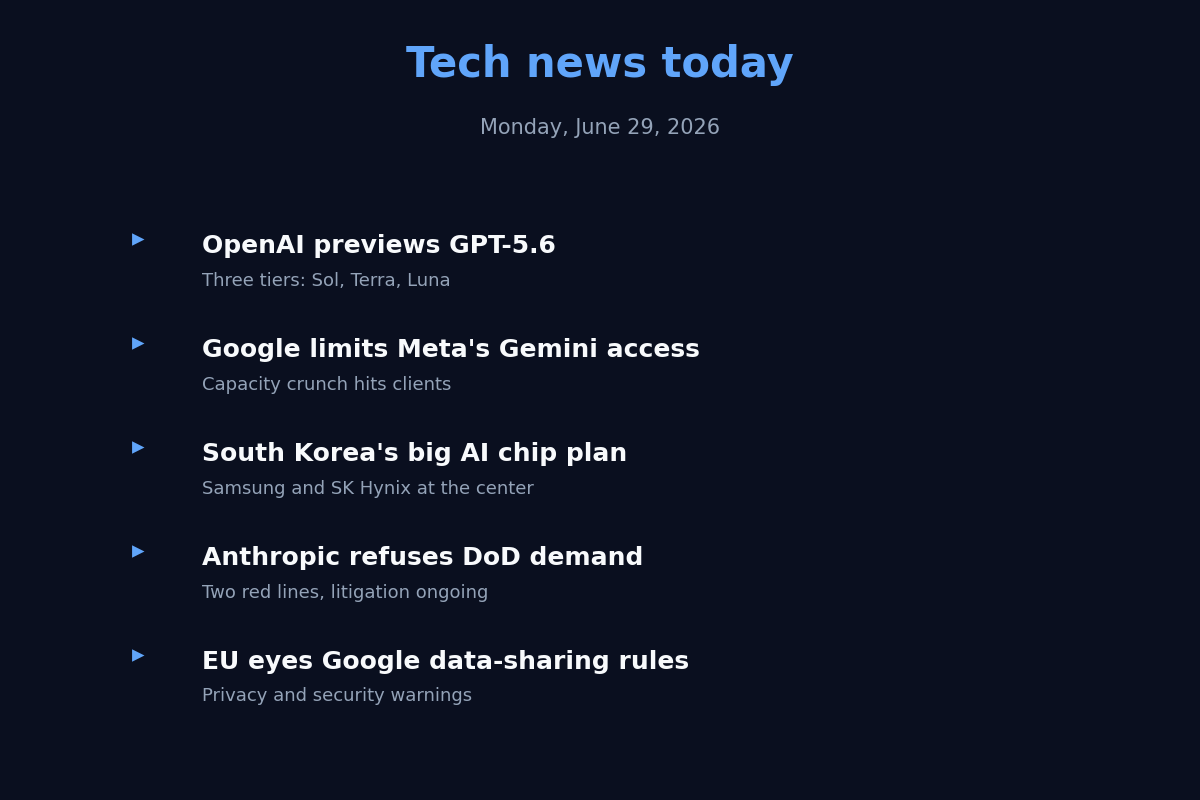
OpenAI previews GPT-5.6 in three tiers
OpenAI previewed GPT-5.6 late last week, calling it the biggest architecture change since GPT-5. Instead of one model, it splits into three tiers with names borrowed from the sky: Sol, the flagship aimed at hard problems, Terra, a balanced everyday model, and Luna, a fast and cheap option built for high volume. The practical idea is simple, match the model to the job so you are not paying flagship prices for a task a lighter model handles fine. Notably, both the new GPT-5.6 models and Anthropic's Claude Mythos 5 now fall under Washington's new frontier AI review process, a sign that the biggest models are starting to be treated like regulated infrastructure. (Build Fast with AI)
Google limits Meta's access to Gemini
Google restricted Meta's use of its Gemini models after Meta asked for more computing capacity than Google could supply. The limits, put in place around March, reportedly delayed some of Meta's internal AI projects. The headline is corporate drama, but the real story underneath is scarcity, even the largest companies cannot get all the AI compute they want, and the firms that own the chips and data centers increasingly get to decide who gets served first. That same shortage is why your phone and laptop got more expensive this year. (Tech Startups)
South Korea puts money behind its chipmakers
South Korea unveiled a large semiconductor and AI investment plan built around Samsung Electronics and SK Hynix. It funds new fabs, more high-bandwidth memory production, AI data centers, and robotics. High-bandwidth memory is the exact component in short supply right now, the stuff that sits next to AI accelerators and has been driving memory prices up all year. A national push to make more of it is the supply side of the same shortage story, and it is a reminder that AI policy is now industrial policy. (Tech Startups)
Anthropic refuses a Defense Department demand
On the policy front, the Department of Defense pushed Anthropic to allow its Claude models to be used for all lawful purposes, a list that reportedly included lethal autonomous weapons and broad domestic surveillance of Americans. Anthropic set two red lines and refused, and the dispute is now in litigation. Whatever you think of the specifics, it is an early, public test of a question that is not going away, who gets to decide what the most capable AI models are allowed to do, the company that builds them or the government that wants to use them. (Build Fast with AI)
The EU weighs new Google data-sharing rules
In Europe, Google's security executives warned that proposed competition rules could create privacy and cybersecurity risks if the company is forced to share more search and Android data with rivals. The EU is weighing final decisions under the Digital Markets Act. It is a familiar tension, opening a dominant platform up to competition can be good for users, but moving sensitive data between companies has its own risks. Both things can be true, and regulators have to weigh them against each other. (Tech Startups)
The thread tying it together
Pull back and four of these five stories are about the same thing, compute and the chips that provide it. New models need more of it, companies are rationing it, countries are racing to make it, and governments are fighting over who controls the result. The AI conversation has quietly shifted from clever demos to plumbing, power, and politics. That is less exciting than a flashy launch, but it is where the real leverage sits.
For more on why that chip shortage keeps showing up in prices, see why Apple's higher prices are probably here to stay, and for the on-device side of the AI story, AI without the cloud. You can see what this studio builds at jcmobileappstudio.com.
Comments
Be kind and stay on topic. Comments are reviewed before they appear.