It is not "AI" in general, it is memory
When people say AI is making tech expensive, the real culprit is narrow and specific: memory chips. Every AI model that runs in a data center needs an enormous amount of fast memory to hold its data, and the chip everyone is fighting over is called HBM, short for high bandwidth memory. It is a premium, stacked version of the same DRAM that goes into your laptop and phone. The companies running the AI boom, Microsoft, Google, Meta, Amazon, and Nvidia's customers, are ordering it by the truckload and paying top dollar.
Here is the catch. Only three companies make most of the world's memory, Samsung, SK hynix, and Micron, and a factory making memory can either make the expensive AI kind or the regular consumer kind, not both at once. Faced with a customer who will pay a fortune for HBM, they have shifted their factory lines toward it. Analysts estimate AI data centers could swallow around 70 percent of high-end DRAM in 2026. Every chip stacked onto an AI accelerator is a chip that never reaches a laptop or a phone.
How that reaches your checkout cart
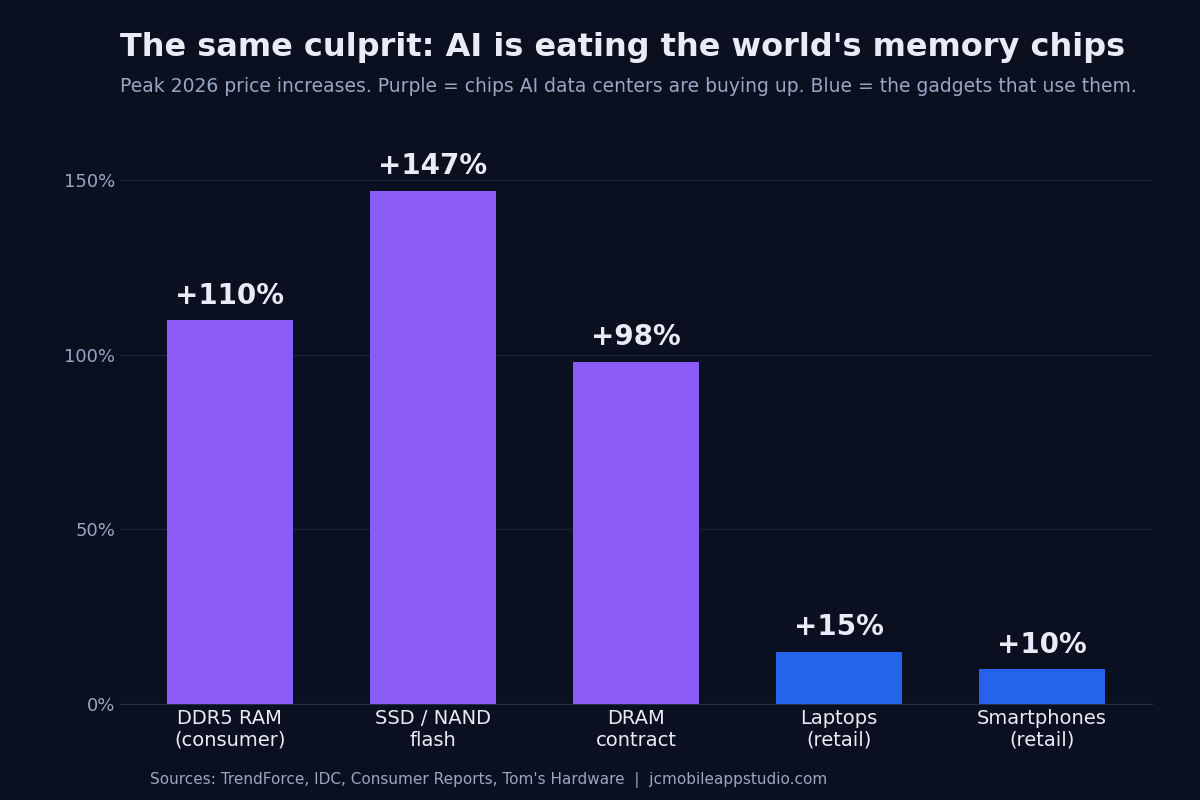
Less supply, same or higher demand, and the price of the leftover memory goes up. A lot. In the first quarter of 2026, consumer RAM prices roughly doubled, DRAM contract prices climbed as much as 98 percent, and NAND flash, the stuff inside SSDs and the storage in your phone, jumped even harder, with some SSD prices up around 147 percent. TrendForce expects another 58 to 63 percent rise in DRAM and 70 to 75 percent in NAND in the second quarter on top of that.
Memory is only one ingredient in a finished device, so the gadgets do not double in price the way raw chips do, but the increase is real and visible. Memory usually makes up something like 10 to 18 percent of what it costs to build a laptop, and that share is climbing past 20 percent. The result, according to industry trackers and Consumer Reports: laptops up by as much as 15 percent, smartphones up by around 10 percent, and SSD upgrades and graphics cards taking the worst of it because they are mostly memory to begin with.
Who gets hit hardest
The more of a product is memory, the bigger the sting. SSDs and RAM upgrade kits are nearly pure memory, so they track the raw price spikes most closely, and PC builders have felt it sharply this year. Graphics cards are next, because they carry their own fast memory, and there are reports of Nvidia no longer bundling that memory with its chips, which pushes card makers to buy from factories that are already fully booked. Phones and laptops feel a softer version, since the screen, battery, case, and other parts dilute the memory cost. The cheapest, lowest-margin devices are the most exposed, because their makers have the least room to absorb a cost jump without raising the sticker.
When does it ease
Not soon, and that is the uncomfortable part. Building a new memory factory takes years, and the manufacturers are committing capacity to AI customers well in advance. Most analysts do not expect meaningful relief before late 2027, and some say 2028. Worse, this looks structural rather than like a normal boom-and-bust chip cycle. When the cheap supply that used to flow to consumer gear has a new, higher-paying home, it does not simply come flooding back. I wrote more about why those higher prices probably stick even after the shortage clears in this companion piece.
What to do about it
A few practical moves. If you need a laptop, phone, or SSD and were on the fence, buying sooner rather than later is reasonable this year, since prices are trending up, not down. Buy the storage and memory you actually need now instead of planning to upgrade later, because the upgrade parts are exactly what is spiking. Refurbished and last-generation models look better than ever against the new list prices. And do not wait for a big post-shortage price drop to swoop in, because based on how pricing usually works, it most likely is not coming.
Your turn: the honest question
All of this raises a question worth sitting with. The same AI boom that is making your gadgets pricier is also the thing giving you better assistants, photo tools, search, and on-device features. So, knowing the trade, where do you land.
Would you give up on AI just to have regular tech prices again?
Tap an answer to vote and see how readers are split.
Figures here were verified on June 27, 2026, and price forecasts are estimates that will change. This is general information to help you make sense of the market, not financial or purchasing advice. The poll is an informal, unscientific reader gut-check, not a real survey.
Comments
Be kind and stay on topic. Comments are reviewed before they appear.